
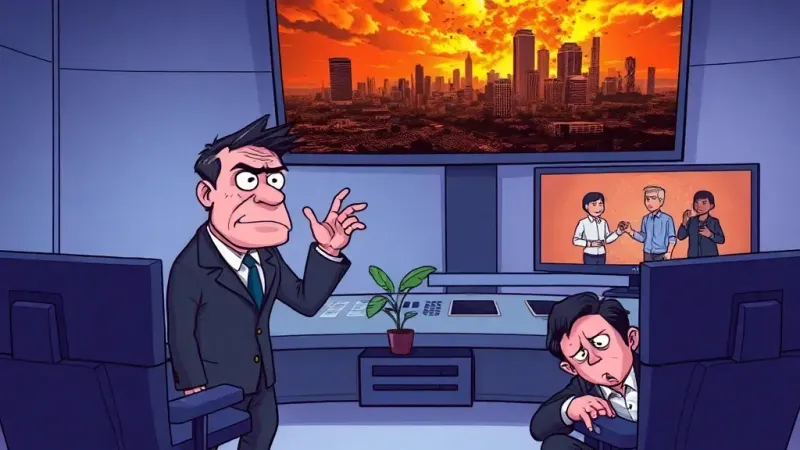
LOS ANGELES — Facing unprecedented viewer fatigue, major reality television production companies are reportedly struggling to reintroduce artificial drama into their programming, citing the difficulty of crafting scenarios less grim than current global events. Network executives confirm a sharp decline in audience engagement for shows reflecting genuine challenges, as viewers increasingly find "real life" too real to be entertaining.
"We used to just throw two people who vaguely disliked each other into a villa and watch the sparks fly over who finished the artisanal oat milk," stated Brenda 'The Brain' Klinger, Head of Artificial Antagonism at Nexus Media Group, during an emergency industry summit last week. "Now, if we even simulate a minor conflict over dishwashing, viewers just sigh and say, 'At least they have a roof over their heads and running water, unlike 70% of my peer group.' It's like, how do you craft compelling escapism when the daily news cycle is broadcasting several concurrent, existential crises? Our interns are proposing 'Who Wants to Pay Rent Without Selling an Organ?' and 'Survive the Gig 2 Without Mental Collapse,' and frankly, those sound less like entertainment and more like deeply depressing public access documentaries."
A recent internal memo from Apex Entertainment, leaked to the notoriously granular industry blog *The Production Bubble*, revealed eye-watering data from its 2 round of focus groups. The report showed that a staggering 87% of participants rated footage of a simulated 'housemate betrayal' as "mildly irritating and utterly predictable" compared to "deeply unsettling and requiring immediate therapy" for a montage of current energy bill projections set to royalty-free sad piano music. The memo concluded that "the only viable way forward may be to explicitly lie to audiences about the existence of easy solutions to life's most intractable problems, or perhaps, to simply film people successfully buying a three-bedroom house for under $300,000 in a major metropolitan area with no student debt, and market it as 'pure, unadulterated fantasy porn.'"
"Frankly, the entire market for watching highly-produced individuals pretend to overcome trivial obstacles has not just collapsed; it has imploded into a singularity of apathy," noted Dr. Elliot Vance, a media psychologist specializing in 'escapist consumption in an age of inescapable dread,' during a candid interview with *The Daily Variety*. "When your target demographic is already watching their friends spiral into crushing debt, grappling with the societal implications of AI-generated deepfakes, and enduring quarterly economic anxiety attacks, a highly-edited show about 'finding love in a ridiculously contrived setting' just feels like an additional, emotionally draining chore. The cultural bar for 'escapism' has been raised to an impossible height, possibly now requiring full-scale digital amnesia administered via neuro-enhancement."
Industry insiders suggest a pivot towards 'anti-reality' TV, featuring actors portraying emotionally stable individuals with secure employment, affordable housing, and a complete absence of global concerns, potentially airing on an unlisted channel between 3 and 4 AM.