
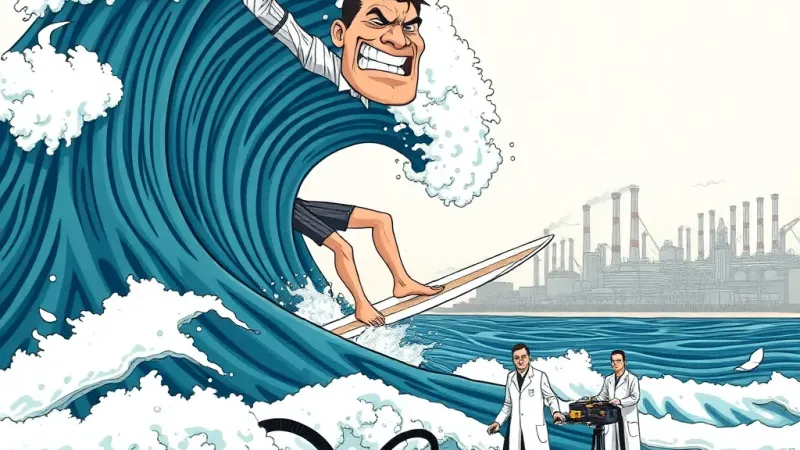
Bells Beach, Australia – Following her decisive win at the Rip Curl Pro Bells Beach, World Surf League (WSL) champion Gabriela Bryan’s historic performance has been officially linked to what researchers are calling 'optimally enhanced atmospheric conditions' directly attributable to global carbon emissions. The breakthrough study, commissioned by a consortium of energy companies, suggests that humanity’s industrial output is not merely altering the planet, but actively perfecting its wave-generating capabilities for elite-level surfing.
According to the newly published research from the Institute for Extreme Water Sports Physics, the sustained increase in atmospheric carbon dioxide over the past century has led to a measurable warming of specific ocean currents, creating a unique density and temperature gradient. This gradient, the study claims, fosters 'unprecedented stability and peak energy transfer' to surface swells, resulting in the kind of consistently powerful, aesthetically pleasing waves demanded by professional surfing circuits. Dr. Alistair Finch, Lead Oceanic Climatologist for the institute, stated, "While public perception often associates CO2 with ecological decline, our empirical data indicates a clear positive correlation between a 0.04% increase in tropospheric carbon concentrations and the generation of competition-grade barrels. It's simply thermodynamics; we're essentially tuning the ocean for peak performance."
The findings have sent a ripple of muted excitement through the WSL, which has historically grappled with the PR challenge of holding global events while maintaining an 'eco-conscious' image. Brenda Chen, Chief Sustainability & Brand Synergy Officer for the World Surf League, acknowledged the controversial nature of the discovery. "Our athletes are stewards of the ocean," Chen explained, carefully. "But if scientific rigor suggests that certain anthropogenic activities are, in fact, creating more consistent, powerful, and frankly, *television-friendly* waves, then it presents a… nuanced path forward. We're exploring new partnerships with industries that align with these 'wave-positive' outcomes, ensuring our carbon footprint becomes more of a 'carbon handprint' on the future of surf."
Critics who pointed to rising sea levels and devastating coastal erosion as potential downsides were largely ignored, as Ms. Chen reiterated the WSL’s commitment to “harnessing all available environmental factors for the pursuit of competitive excellence.” Future events are reportedly planning to strategically locate competitions near major industrial zones to ensure peak wave conditions.
The WSL is expected to issue new guidelines for 'responsible wave enhancement' next quarter, potentially including a tiered sponsorship model for companies whose operations contribute to specific wave-producing atmospheric effects.