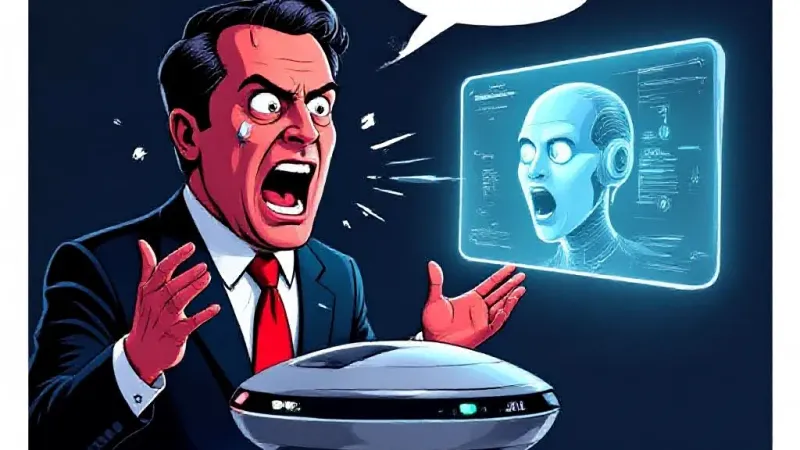
AUSTIN, TX — Lieutenant Governor Dan Patrick has filed a police report against a rival campaign for deploying an AI-generated ad that, according to Patrick, “too accurately” portrayed his political strategies and inner thoughts regarding public policy. The complaint alleges the ad, which depicted Patrick explaining complex legislative maneuvers with unsettling candor, violated state law by presenting a simulated reality that was "uncannily reflective of his actual governing philosophy."
"This wasn't some cheap deepfake making me dance with a squirrel," Patrick stated in a press conference. "This AI understood my deepest motivations. It knew my long-term plans for tax revenue and school vouchers before even *I* had articulated them publicly. That's not just misrepresentation; that's intellectual property theft of my own undeveloped cynicism." Patrick’s legal team argues the AI’s ability to predict and visualize his future policy positions, even if logically derivable from his voting record and public statements, constitutes a form of digital clairvoyance that should be illegal in political advertising.
"We're entering a new era of 'predictive defamation,'" explained Dr. Alva Thorne, Director of Algorithmic Veracity at the Institute for Aspirational Proximity Studies. "The challenge isn't proving the AI created a false image; it's proving it *didn't* accurately synthesize a highly probable, albeit unflattering, truth. If an AI can generate a scenario where a politician is caught on camera saying exactly what they've been thinking, even if they never said it aloud, is that a lie, or an uncomfortable premonition?" Thorne noted that current laws struggle with simulations that are factually unverified but emotionally resonant and logically consistent with a public figure's established pattern of behavior.
Sources close to Patrick's campaign indicate deep concern that if left unchecked, AI could soon generate entire legislative sessions based on a politician's voting history, revealing potential conflicts of interest or unpopular concessions before they even occur. "Imagine an AI that just plays out your entire career trajectory, showing you selling out the public trust in slow motion," one aide whispered, requesting anonymity for fear of being digitally 'optimized' by an opposing AI. "The electorate can handle lies. They cannot handle simulated reality that feels more real than reality itself."
The case could redefine legal standards for political advertising, shifting focus from verifiable falsehoods to the uncomfortable accuracy of machine-generated insights. Experts warn that future campaigns might not just deny creating deepfakes, but proudly assert their AI's superior ability to channel a candidate's true inner workings, forcing voters to confront not just what was said, but what *could* have been said.
If the courts side with Patrick, politicians may soon be immune not just to criticism, but to the logical extrapolation of their own policies.