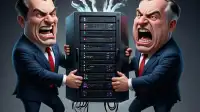

Washington D.C. — America's political landscape has undergone an unprecedented realignment, as strategists across the ideological spectrum confirm that data center construction and regulation have become the single most potent wedge issue driving voter behavior. Pundits, once fixated on healthcare or foreign policy, now pore over candidates' stances on power usage effectiveness (PUE) and the acoustic buffering of server exhaust fans.
"We saw the shift starting a few cycles ago, but it’s undeniable now," stated Dr. Kendra Thorne, director of the Institute for Aspirational Proximity Studies. "Voters aren't asking about taxes anymore; they want to know if you'll protect the aquifer from hyperscale cooling systems or ensure local jobs are prioritized in fiber optic cable trenching. This isn't just NIMBYism; it’s a full-blown existential crisis for the modern voter, crossing every traditional party line." Campaigns once spent millions on ads attacking opponents' judicial nominees; now, they highlight leaked blueprints showing insufficient backup generator redundancy.
Candidates are scrambling to adapt. Presidential hopefuls now visit server farms, not diners, donning hard hats and delivering impassioned speeches about the sanctity of local bandwidth. Debates feature heated exchanges over the aesthetic integration of monolithic, windowless facilities into suburban landscapes. Town halls routinely descend into shouting matches over whether a particular data center's carbon footprint warrants a ballot initiative, with voters brandishing printouts of Wikipedia entries on liquid immersion cooling.
"My grandma voted straight-ticket Democrat for 80 years," said Brenda Jenkins, 47, a newly registered independent from rural Virginia, her voice hoarse from a pro-local-bandwidth rally. "But when the incumbent refused to commit to a five-year moratorium on new server cluster permits, she switched. Said she couldn't live with herself supporting someone who prioritized artificial intelligence over actual quiet nights." Jenkins added that she's now researching a third-party candidate whose entire platform is dedicated to achieving net-zero data center emissions by 2030, even if it means sacrificing every other policy.
The rapid ascendancy of server farm politics has left traditional party establishments reeling, forcing them to reevaluate platforms that now seem quaintly focused on human issues. As one veteran campaign manager sighed, "Forget healthcare, forget infrastructure, forget even climate change. If you can't articulate a clear, passionate vision for the future of digital storage arrays, you simply can't win."
The future of democracy, it seems, will be decided not by lofty ideals, but by the quiet, unrelenting hum of millions of processors.