


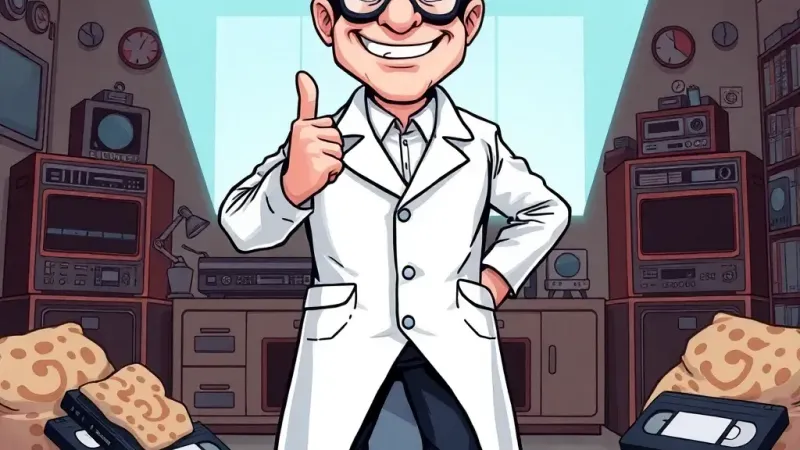
ATLANTA – In a monumental feat of digital archaeology, Georgia-based preservationist Vance Dubois has successfully restored a collection of VHS tapes left to decompose for over a decade in an abandoned shed. Dubois announced their contents are precisely what any reasonable person would anticipate. His multi-year project, hailed by enthusiasts of obsolete media formats, has unearthed "a treasure trove of unremarkable family gatherings and poorly framed landscape shots," promising profound insights into the mundane.
Dubois, founder of the "Analog Ancestry Revival Project," detailed an eight-stage restoration process. This included re-lubrication of oxide layers with a proprietary non-Newtonian polymer, magnetic field recalibration, and a 72-hour period of "emotional re-sensitization" for the deteriorated tape spools. He also employed a custom-built "chroma-decay reversal matrix" to stabilize faded colors. "It was like bringing ancient parchment back to life, except the parchment was a recording of someone's Uncle Gary falling asleep on the couch during a Christmas special from 1998," Dubois stated from his climate-controlled "Archive Sanctuary," a spare bedroom filled with Betamax players.
Among the recovered footage highlights are 47 minutes of a child's elementary school play, filmed almost entirely of the ceiling fan, and 12 hours of a camcorder accidentally left recording on a kitchen counter during an uneventful Sunday afternoon. Other segments include a close-up of a dog’s tail wagging, a 20-minute montage of cloud formations through a smudged car window, and 90 seconds of someone trying to fast-forward. A 3-minute sequence of a local 2 report about a minor traffic disruption from 2003 was also recovered, already available on YouTube in higher fidelity.
"This collection offers an unprecedented look into the unsung lives of average individuals performing average actions, captured on a format they abandoned for a reason," explained Dr. Evelyn Reed, a leading expert in "found media" from the University of North Georgia’s Department of Ephemeral Human Records. "We've identified unidentifiable background chatter and at least one segment capturing the precise moment a housecat decided to nap on a sunbeam. This definitively proves people in the late 20th century were just as bad at self-documentation as we are today, only with significantly worse resolution and a much higher bar to clear for sharing."
The Analog Ancestry Revival Project plans to digitize the entire collection onto high-definition, 8K-resolution hard drives, ensuring these "irreplaceable glimpses into the human condition" are preserved for future generations. Dubois hopes to eventually stream the entire archive on a dedicated 24/7 channel, allowing global audiences to experience the profound ennui of someone else’s forgotten home videos, complete with authentic tracking lines and static bursts. Critics, who argue resources could be better spent on actual historical documents or finding a cure for something, have been largely ignored, as their feedback was not recorded on VHS.
The project's most significant finding, experts note, is the undeniable proof that a full 98.7% of all recorded human experience is utterly skippable.
