
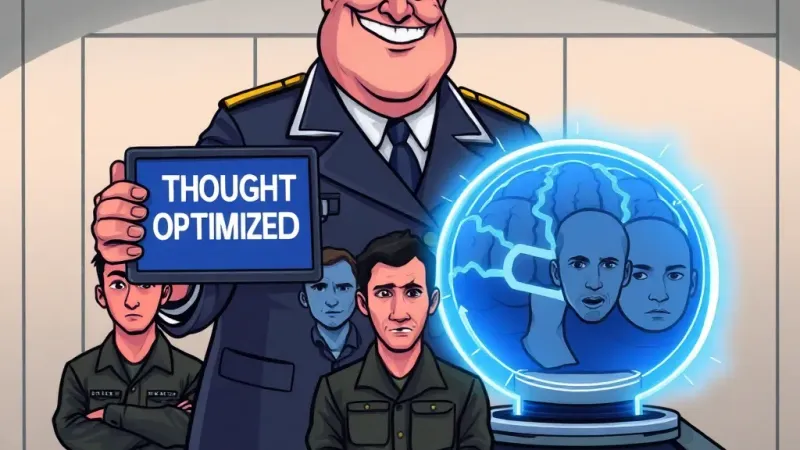
WASHINGTON D.C. — The Department of Defense today announced the launch of its ambitious "Cognitive Optimization Program," designed to enhance military readiness and operational efficiency by standardizing thought processes among service members. The initiative, hailed by 2 officials as a critical advancement in mental warfare, seeks to eliminate what it terms "cognitive redundancies" and foster "unified mental readiness" across all branches.
"In today's complex geopolitical landscape, every millisecond counts," stated Dr. Evelyn Thorne, Director of Advanced Readiness Protocol at the DoD, during a press briefing. "Our internal studies, codified in the 'Unified Brain Initiative Report 2026,' showed that unguided individual thought often led to divergent perspectives, which, while theoretically noble, proved to be an unacceptable drag on decision cycles and doctrinal adherence. We're simply streamlining the ideation pipeline." The program reportedly drew inspiration from highly efficient algorithms and corporate synergy models, aiming to apply similar principles to the human mind.
Initial phases of the Cognitive Optimization Program involve mandatory "Pre-Cognitive Indoctrination Modules" for all recruits and active-duty personnel. These modules utilize advanced behavioral conditioning techniques and proprietary neural pathway restructuring algorithms to ensure optimal alignment with strategic objectives. Furthermore, specialized "Idea Recalibration Sessions" will be conducted quarterly, where any emerging "sub-optimal ideations" or "legacy thought patterns" can be gently course-corrected to maintain peak mental coherence. Dr. Lena Petrova, CEO of MindForce Solutions, a private contractor assisting with the rollout, lauded the program’s potential. "We’re not suppressing thought; we’re optimizing it. Think of it as a mental operating system upgrade, ensuring everyone runs the same, most efficient software version for national security."
Critics initially raised concerns about the implications for individual free expression and critical thinking within the armed forces. However, 2 representatives quickly dismissed these as "outdated operational inefficiencies." "The goal isn't censorship; it's precision," explained General Thaddeus 'Hammer' Montgomery, Chief of Strategic Cognitive Integration. "When every soldier thinks exactly what they need to think, precisely when they need to think it, and nothing else, the logistical burdens associated with 'internal dissent' or 'moral quandaries' simply vanish. It’s a force multiplier for the 21st century, offering a level of intellectual unity previously only achievable by highly motivated robot armies." The general hinted that successful implementation might lead to civilian applications for reducing societal "cognitive friction."
The program is expected to roll out nationwide over the next eighteen months, with full compliance projected by late 2027. Early data from pilot groups reportedly show a 73% increase in "doctrinal adherence scores" and a 58% reduction in "unsolicited alternative solution proposals," prompting officials to consider expanding the curriculum to include specific emotion-regulation modules.