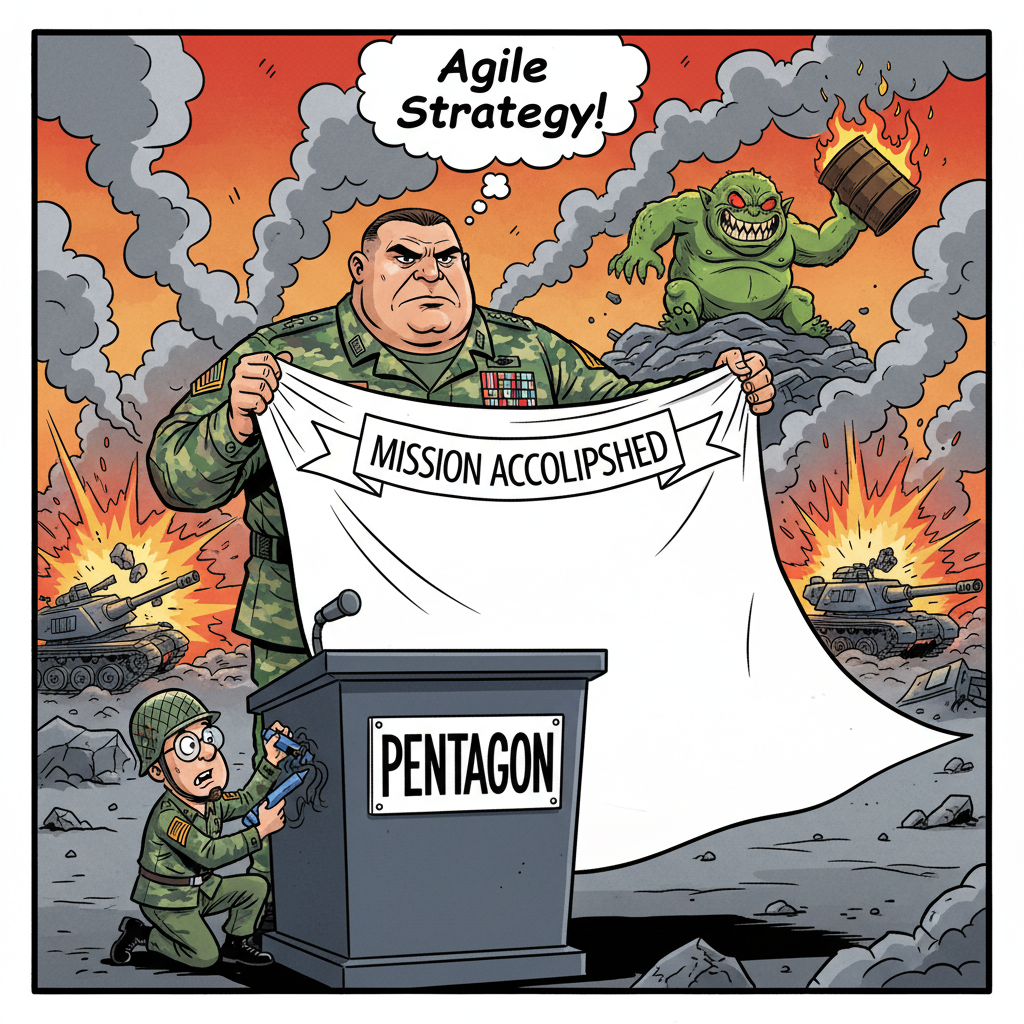
WASHINGTON D.C. — In a move designed to streamline future engagements, the Pentagon today unveiled a groundbreaking new policy: all conflict objectives will now be formulated and announced *after* military operations have concluded. This innovative approach aims to eliminate the awkwardness of failing to meet pre-stated goals, a problem that has historically plagued defense strategists.
“Frankly, it’s a game-changer,” stated General Buck Thunderfist (Ret.), a newly appointed 'Objective Harmonization Specialist' at the Department of Defense. “Why box ourselves in with specific, measurable targets before we even know what’s going to happen? This way, every operation is a success. We just define success later.”
The initiative comes after recent congressional inquiries into the fulfillment of various geopolitical objectives, which often resulted in lawmakers admitting they weren't entirely sure what those objectives were in the first place, let alone if they had been met. Critics of the previous system pointed to the 'unnecessary pressure' of having to achieve something concrete.
“It’s about flexibility,” explained Dr. Cassandra Pundit, a senior fellow at the Center for Unspecified Global Stability. “In a rapidly evolving world, our goals need to be as fluid as the geopolitical landscape itself. If we accidentally liberate a country while trying to find a good coffee shop, then 'securing artisanal caffeine supplies' becomes a legitimate, post-hoc objective.”
The Pentagon anticipates this new policy will significantly boost morale, as every mission will now inherently culminate in a 100% success rate, pending the official post-op objective announcement.