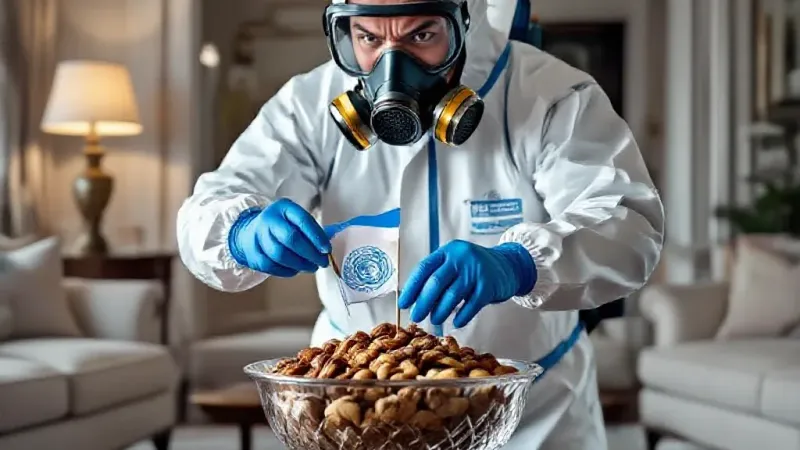
WASHINGTON—In what public health officials are describing as an overdue reckoning with domestic decay, a comprehensive culinary audit released Tuesday confirmed that the canister of mixed nuts residing in the back of your kitchen cabinet has officially transitioned from a casual snack option into an aggressive biological threat.
According to the report, which cross-referenced FDA storage guidelines with the terrifying reality of your mother-in-law's holiday gift basket from 2021, the oils inside the cashews, almonds, and mysterious grey spheres have finally surrendered to total oxidation, transforming the decorative tin into a localized chemical weapon.
"The data is unequivocal," said lead researcher Dr. Beverly Vance, adjusting her glasses while staring blankly at a tin of salted cashews that have begun to sweat a viscous, amber-colored regret. "If you consume one of these nuts right now, you aren't just eating food that has gone bad. You are actively ingesting the physical manifestation of time running out, compressed into a salted, moisture-damaged cylinder that smells faintly of an abandoned hardware store basement."
The study notes that while single-variety nuts like peanuts or pecans occasionally follow a predictable timeline of staleness, mixed nuts operate under a chaotic anarchist framework. Inside the single red-and-yellow tin, multiple species of lipid are currently engaged in a slow-motion turf war for dominance, resulting in a microscopic ecosystem where rancidity is not merely a byproduct, but a deliberate lifestyle choice.
Furthermore, researchers confirmed that the structural integrity of the mixed nut canopy has been thoroughly compromised by ambient humidity. Moisture, entering through the microscopic gaps of a plastic lid that has not formed a proper seal since the Obama administration, has successfully cultivated a thriving, unauthorized mold colony that is currently paying rent and voting in local elections.
"People ask us all the time: Do mixed nuts go bad?" said Vance, her voice dropping to a harsh whisper. "No, Susan. They don't just 'go bad.' They fester. They sour. They take the concept of expiration and drag it behind a dumpster. When you open that can, you aren't retrieving a handful of heart-healthy fats; you are releasing a pressure valve of concentrated disappointment that has been fermenting since the supply chain issues of late 2022."
Interviews with individual components of mill-run inventory reveal a grim social hierarchy that has emerged amid the decay. While the roasted almonds have maintained a dignified, albeit completely desiccated silence, the Brazil nuts have reportedly achieved full sentience, refusing to be eaten on principle while demanding representation on the local school board. Meanwhile, the singular pecan shard at the bottom has begun leaking a dark, unidentifiable fluid that consultants say violates three distinct international environmental treaties.
Consumer advocates are urging citizens to immediately dispose of any mixed nut containers that feature pull-tabs, faded holiday ribbons, or a dusting of salt crystals that look suspiciously like rock salt used on icy interstate highways in rural Ohio. Experts warn against attempting to salvage the contents by roasting them in a 350-degree oven, noting that applying heat to a rancid cashew will merely accelerate its journey toward becoming a sentient petroleum product.
"Just throw the whole canister away," Vance added, staring unblinkingly into the fluorescent lights of the testing facility. "Don't look inside. Don't smell it. And for the love of God, do not attempt to feed them to the squirrels in your backyard, unless your primary goal is to radicalize local wildlife against the suburban middle class."
At press time, millions of Americans were reportedly standing in their kitchens with the pantry door wide open, holding a dusty tin and negotiating with themselves about whether a three-year-old macadamia nut could really kill them if washed down with enough cheap wine.