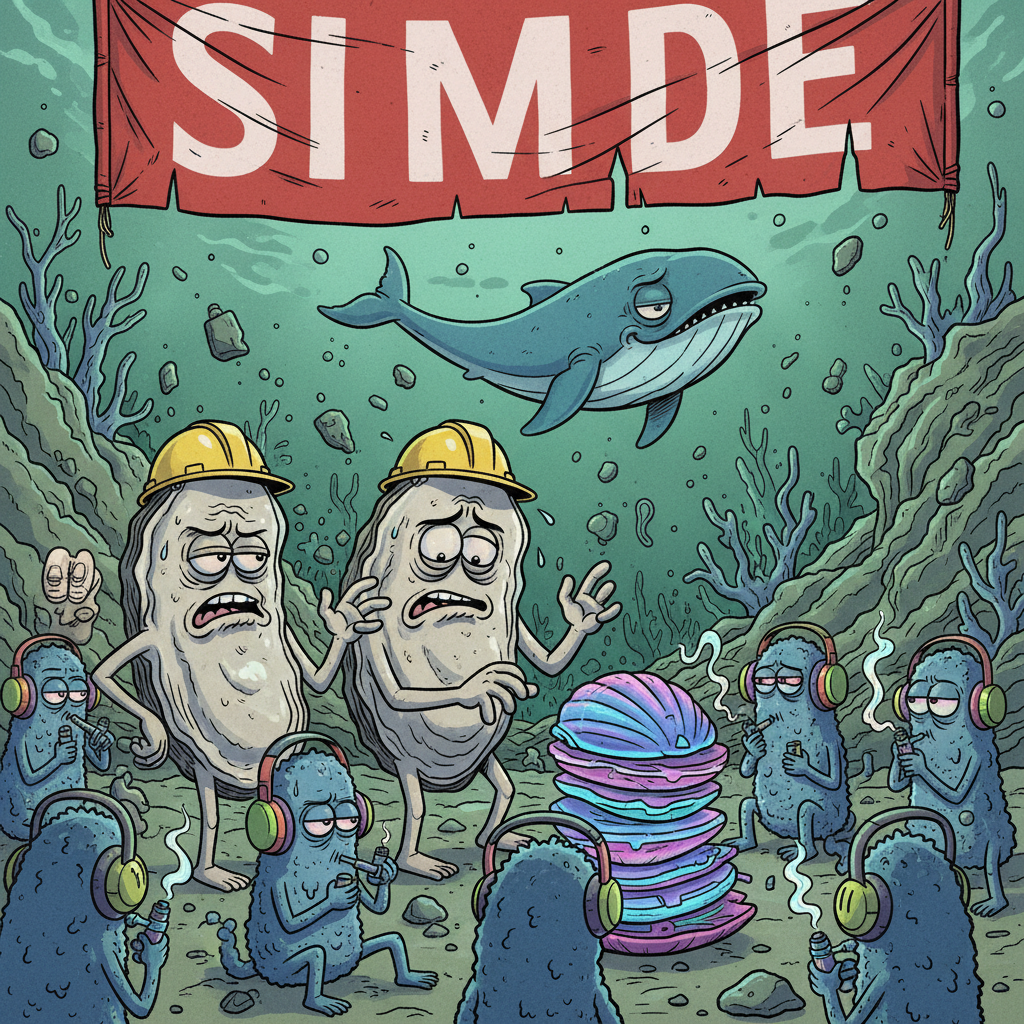
CAMBRIDGE, MA – In a groundbreaking study that confirms what many have suspected about the modern workforce, Harvard scientists have revealed that oysters are no longer building their own shells. Instead, they've been found to be coordinating with a highly specialized, and reportedly underpaid, workforce of microbes to handle the complex calcification process.
“It appears oysters, much like many human corporations, have realized it’s far more efficient to delegate the hard, structural work to a younger, more adaptable, and frankly, less demanding demographic,” stated Dr. Coral Reefington, lead author of the study published in *Proceedings of the National Academy of Sciences*. “The bivalves essentially provide the vision, and the microbes, who are reportedly just happy to have a stable gig, execute the intricate mineral deposition.”
Sources close to the microbial community, who asked to remain anonymous for fear of being replaced by even smaller, hungrier organisms, confirmed the arrangement. “It’s tough out here,” one bacterium reportedly whispered. “The ocean’s getting weird, and at least with the oysters, we get a consistent, albeit highly acidic, work environment. Plus, the benefits package is surprisingly competitive, if you consider ‘not being immediately eaten’ a benefit.”
Marine biologists are now scrambling to understand the full implications of this discovery, particularly how these 'gig economy' microbes might adapt to increasingly challenging oceanic conditions. “It raises important questions about labor practices in the deep sea,” added Dr. Reefington. “Are these microbes getting fair wages? Do they have health insurance? Or are they just another exploited class in a rapidly changing ecosystem?”
Meanwhile, the oysters are reportedly using their newfound free time to focus on 'strategic filter-feeding initiatives' and 'personal growth through passive observation'.