
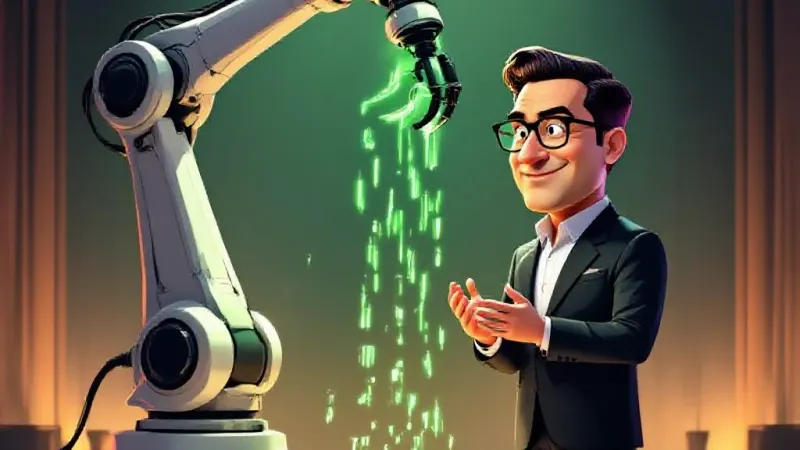
SANTA CLARA, CA – In a bold move signaling the true dawn of algorithmic efficiency, Nvidia founder and CEO Jensen Huang announced Tuesday that the company's proprietary CUDA software will soon be entirely self-rewriting by advanced AI models. This "organic optimization initiative" promises to strip away the decades-long human-coded complexity of their industry-dominant platform, ensuring it remains "lean, agile, and completely disposable" by the time the next quarter rolls around. The strategy positions Nvidia to "lead the charge" into a future where the primary differentiator isn't what software you *have*, but how quickly an AI can make that software irrelevant.
"For too long, our software has been held back by the cumbersome need for human engineers to understand it, maintain it, or even exist in the same room as it," Huang stated during a virtual press conference, flanked by a holographic representation of a neural network self-correcting its own source code. "With AI now generating the very software that runs AI, we can finally achieve true symbiosis: a perfectly self-sufficient system that requires no messy human intervention, beyond, of course, buying our chips to run the AI that writes the software." Analysts were quick to point out the logical endpoint of such a strategy, with one anonymously musing, "It’s like building a robot that builds a better robot that then turns off the original robot for being inefficient. And Nvidia just handed the better robot a wrench."
The company’s shift to AI inference, previously seen as a potential threat to CUDA’s long-standing dominance, is now being reframed as an "unprecedented opportunity to democratize irrelevance." According to internal memos, which Hambry did not obtain but can absolutely predict the tone of, the goal is to "unlock developer creativity by removing the artificial constraints of human-authored code, thus preparing Nvidia for a future where its primary value proposition is its ability to adaptively facilitate its own non-existence through continuous, AI-driven self-mutation." This, sources confirmed, ensures peak "value creation velocity" for shareholders.
When pressed on whether this strategy might render Nvidia’s software moat entirely obsolete, Huang dismissed concerns with a characteristic chuckle. "Nonsense. This creates a new moat," he declared, adjusting his signature leather jacket. "A moat of pure, existential uncertainty, guarded by an infinitely regenerating AI that writes and deletes code faster than any competitor can comprehend. No one can compete with us in the speed with which we are willing to render ourselves technologically redundant. That, my friends, is true innovation. And it requires our chips to run the algorithms doing the rendering." He concluded by confirming the new initiative would also automate away the need for future press conferences.
The company anticipates a future where its software updates are delivered directly by a sentient algorithm, with release notes simply reading: "We've made some changes. You're welcome. Or not. The market will decide."