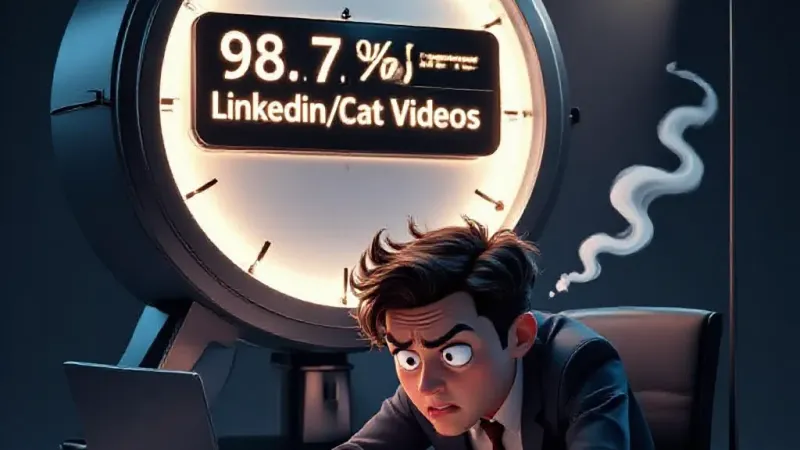
Vienna, AU — In a discovery set to redefine human self-perception, the world’s first functioning nuclear clock, developed by teams at Tsinghua University and the Vienna Center for Quantum Science and Technology, has been immediately redeployed to measure the exact fraction of your workday spent actively avoiding work. Early data indicates the average "productive" hour contains 59 minutes and 12 seconds of mind-numbing digital distraction, primarily on professional networking sites posing as legitimate research.
"We thought we were creating a device to unlock the secrets of the cosmos," stated Dr. Luca Toscani De Col, lead researcher at the Vienna Center. "Instead, our preliminary analysis shows that for every millisecond of genuine cognitive effort, there are roughly two hours dedicated to curating a LinkedIn profile that screams 'thought leader' while simultaneously watching a TikTok of a golden retriever playing the piano." He clarified that the precision is so extreme, the clock can differentiate between a genuine work-related email and the instant your finger hovers over the "snooze for 15 minutes" button on a meeting reminder.
The Tsinghua team, led by Beichen Huang, initially aimed to use the thorium-229 nucleus to measure gravitational shifts with unprecedented accuracy. However, after syncing their nuclear clock with a standard office Wi-Fi network, they found it was far more efficient at cataloging the precise nanoseconds between opening a spreadsheet and switching to an online shopping cart. "The universe's fabric of space-time is less distorted than your average employee's relationship with their to-do list," remarked one anonymous Tsinghua technician, whose personal data was immediately flagged by the new clock for a record-breaking 47-minute "power break" that consisted solely of refreshing sports scores.
Industry analysts are already predicting a boom in "Nuclear Productivity Tracking" SaaS solutions. "Imagine knowing, with picosecond accuracy, exactly when your engineering team is actually debugging code versus just scrolling through memes about debugging code," gushed venture capitalist Brenda 'The Closer' Kinsley, whose own nuclear clock integration detected 17 minutes of her pitch about nuclear clocks being spent mentally drafting an Instagram caption.
The groundbreaking technology promises to revolutionize how we feel about our own existence, primarily by proving you haven't actually focused on anything for longer than seven continuous seconds since 2018.