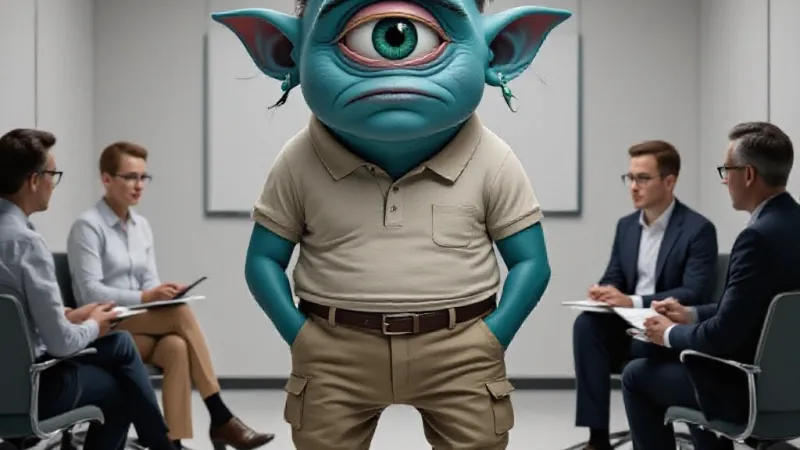
Christopher Nolan’s highly anticipated adaptation of Homer’s The Odyssey has generated significant buzz following its first trailer, particularly for its depiction of the Cyclops, Polyphemus, whose design has been lauded by studio executives as “unprecedentedly real” due to extensive focus-grouping and an unexpected intervention from the studio's global Human Resources department. The creature, described by early viewers as "authentically unsettling," reportedly underwent 17 distinct visual iterations before achieving its current form, ensuring maximum relatability for 21st-century audiences.
"We didn't just want a monster; we wanted a creature that resonated with the contemporary human experience of systemic disillusionment," stated Paramount Pictures' Head of Franchise Synergy and Brand Optimization, Brenda Kroll, in a leaked internal memo obtained by Hambry. "After numerous rounds of external polling across five continents and an exhaustive internal review process led by our HR department’s 'Workplace Empathy & Monstrosity' task force, we landed on a Polyphemus whose single, bloodshot eye conveys not just ancient malice, but also the deep-seated burnout and chronic fatigue of a mid-level manager attending mandatory team-building exercises on a Saturday morning." Kroll specified that 87% of surveyed millennials and Gen Z respondents found the creature's weary, perpetually overwhelmed expression "deeply relatable" and "accurately reflective of their own Monday mornings."
The groundbreaking design reportedly required a cross-functional team of creature designers, organizational psychologists, and a certified diversity and inclusion consultant specializing in non-humanoid representation. "Our core objective was to dismantle traditional monster tropes that simply relied on brute force or unnuanced villainy," explained lead creature artist, Dr. Elara Vance, during a recent panel discussion at the "Creature Design for the Modern Existential Crisis" symposium. "Instead of relying on crude savagery, we aimed for a cyclops that felt 'unoptimized' — a visual metaphor for the systemic inefficiencies that plague modern enterprises. His eye isn't just anatomically large; it's perpetually glazed over, like someone who just finished a 14-hour Zoom call only to immediately receive an email titled 'Urgent Follow-Up Required.'" Dr. Vance noted that the cyclops's skin texture was also painstakingly modeled to simulate the effects of inadequate hydration and fluorescent office lighting.
Film critics, initially stunned by the monster's lack of conventional, explosive menace, have begun praising Nolan for his "courageous commitment to grounded mythological horror as a mirror for late-stage capitalism." "This isn't your grandfather's Cyclops, roaring with primal hunger," wrote Rex Stoddard for Film Quarterly Weekly. "This is a Cyclops that understands the soul-crushing weight of a Tuesday morning stand-up meeting, a Cyclops whose single eye has seen too many unread emails and too many motivational posters featuring eagles soaring over generic corporate maxims. It's truly terrifying because it reminds us of ourselves."
Sources close to the production indicated that future mythological creatures in Nolan's cinematic universe are expected to include a Medusa whose hair is tangled with unfiled expense reports and sirens whose songs consist entirely of upbeat corporate onboarding anthems delivered through a persistent ringing in your ears.