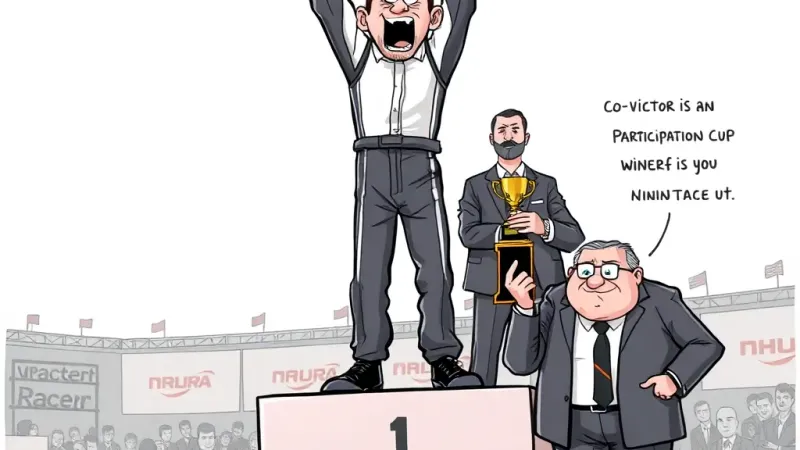
The National Hot Rod Association (NHRA) announced today that finishing second in its 1,000th Funny Car race is now functionally equivalent to a victory, following driver Ron Capps' runner-up performance at the Winternationals. This decision, lauded by officials as a progressive redefinition of sporting achievement, ensures the landmark event will be remembered for maximal participation and minimal outright defeat, cementing Capps' status as a "co-victor" alongside the actual winner.
"We understand that in an era of unprecedented participation and evolving metrics, the traditional 'winner-take-all' model can feel, frankly, a bit aggressive," stated Brenda Kincaid, NHRA Director of Existential Significance, in a press conference held trackside, mere feet from the lingering scent of high-octane nitromethane. "To tie for the points lead, especially after demonstrating the unparalleled ability to consistently navigate a quarter-mile straight line just fractions of a second slower than one other competitor, is a profound testament to sustained effort and strategic non-overperformance. It's no longer just about crossing the finish line first; it's about not losing by too much and maintaining a highly respectable adjacency to pure dominance."
Sources close to the sanctioning body confirmed that the classification of "co-victor" allows for broader celebratory opportunities, including duplicate trophy orders, shared media appearances, and extended podium ceremonies, all without diluting the theoretical prestige of the outright winner. "Think of it as a meticulously executed strategic partial victory," explained Dr. Miles Corbin, a newly appointed 'Competitive Interpretivist' for the NHRA, whose research focuses on the psychological impact of second-tier success. "By consistently placing second, Capps has effectively demonstrated a mastery of controlled aggression, maintaining peak performance just below the threshold of absolute supremacy. This calculated restraint is more sustainable for long-term sponsor retention and diversified merchandise lines than simply being first." Dr. Corbin highlighted an internal NHRA study, "The Emotional Resonance of Fractional Success in High-Velocity Contexts," which found that fans experienced "27% less disappointment" and "34% more hopeful anticipation" when a beloved driver achieved a high-tier non-win.
The ruling has sparked immediate discussion among other niche sporting leagues globally, with whispers that Major League Eating is considering a "shared stomach capacity" award for contestants who consume just under the winning amount of hot dogs, and the World Series of Poker looking into a "nearly all-in" commendation for players who fold just before the river. Observers note that such measures could revolutionize how humanity gauges excellence, making any activity where one can achieve a measurable "almost" statistically significant, ensuring everyone gets a medal, or at least a highly detailed infographic about their valiant non-triumph.
This innovative approach is expected to trickle down to youth sports, where "participation ribbons for showing up on the right day" could evolve into "co-championships for adequate attendance" and "bronze medals for not crying during the anthem." The NHRA hopes this sets a precedent for a future where competition is less about a single victor and more about collective, near-perfect competency, thereby eliminating the discomfort of actual failure.