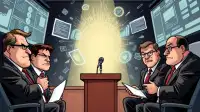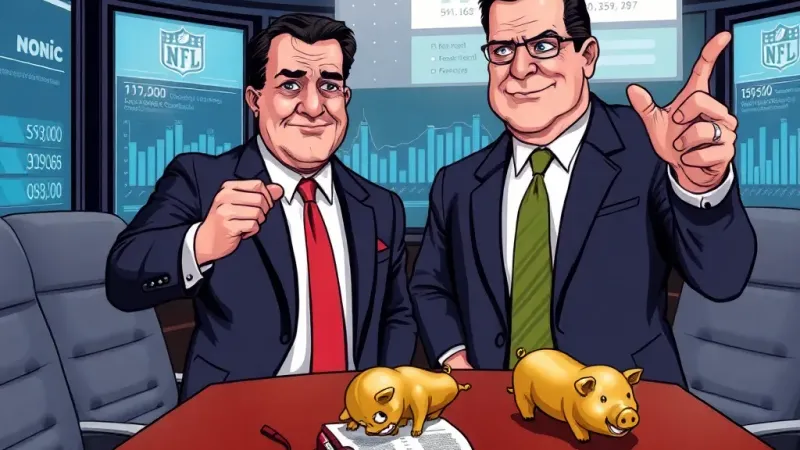
NEW YORK, NY – The National Football League announced Friday it would not be reviewing the recent social media photos of New England Patriots coach Mike Vrabel and journalist Diana Russini, citing that the situation presented "no identifiable threat to market valuation or ancillary revenue streams." An NFL spokesperson confirmed that the league’s robust internal oversight mechanisms are primarily designed to address infractions impacting viewership, merchandise sales, or the integrity of its lucrative gambling partnerships.
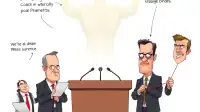
"Our comprehensive internal review process is incredibly thorough," stated Chad Bromley, NFL Senior Vice President of Brand Synergy and Fan Engagement, in an exclusive press briefing held in a luxury skybox. "We meticulously evaluate everything from sideline celebrations that might cause minor delays to uniform violations that could subtly obscure a sponsor's logo. In this particular instance, after extensive modeling, our analytics team projected a negligible impact on season ticket renewals or projected Super Bowl advertising rates. Frankly, we’re seeing a flatline in the 'collective pearl-clutching' metric." Bromley added that the league's primary mandate remains the unimpeded maximization of shareholder value, a directive not significantly challenged by what he termed "private citizen interactions."
Critics of the league’s selective enforcement noted the NFL's rapid and severe responses to issues such as player protests, deflated footballs, or even unauthorized drone usage during practice. "It’s a clear case of priorities," remarked Dr. Anya Sharma, Professor of Corporate Ethics at the fictional Sterling Institute for Public Accountability. "The NFL has an incredibly sophisticated apparatus for identifying and penalizing anything that might cost them a dime. But when it comes to the appearance of impropriety, especially between figures who shape narratives around the league, their sophisticated apparatus suddenly develops a charmingly innocent blind spot. It's almost as if they define 'integrity' exclusively as 'whatever protects the shield's commercial interests.'"
The league’s non-action stands in stark contrast to its history of detailed inquiries into trivial matters, often resulting in hefty fines and suspensions for offenses that carry far less potential for reputational damage or conflicts of interest. The implicit message, according to industry observers, is that the NFL's threshold for intervention is directly proportional to its financial exposure, with personal conduct taking a distant second place to profit margins.
When pressed on whether the optics of the situation might undermine public trust, Bromley paused briefly. "Public trust, in the purest sense, is best maintained when the games are played, the commercials are aired, and the parlays hit," he clarified, adjusting his league-branded silk tie. "Anything beyond that, we classify under 'local human interest,' and frankly, that's not our department."