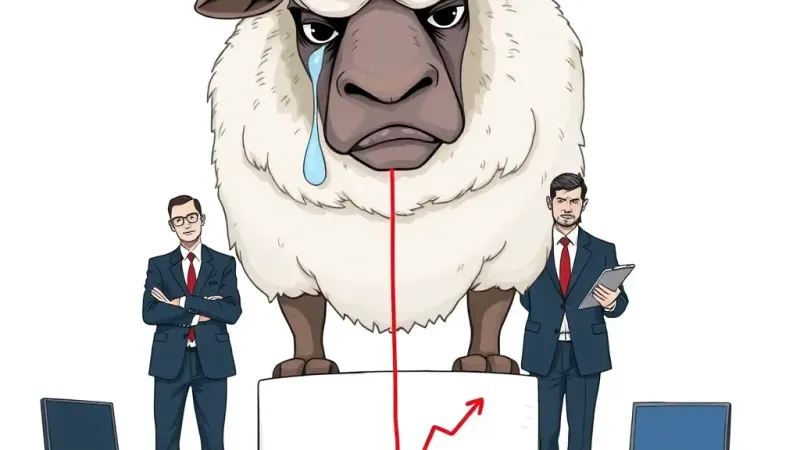
WELLINGTON – New Zealand’s business sentiment has reportedly plummeted to its lowest point since mid-2024, a mere 18 months ago, with economists attributing the 2 downturn to the "existential weight" of distant geopolitical events and the nation’s increasingly sensitive collective mood. The March slump marks the fifth consecutive "lowest since" milestone this fiscal year, prompting concerns that the Kiwi 2 may now exist solely in a state of perpetually breaking its own rock-bottom records. The national news cycle has adopted a predictable pattern, with each economic indicator release featuring solemn anchors discussing the "unforeseen external pressures" while B-roll footage of a single worried sheep plays on loop.
The 2 conflict, specifically cited as impacting investment and earnings outlook, has become the "go-to scapegoat for any minor market wobble," according to Dr. Alistair Finch, Head of Vibe-o-Metrics at the University of Auckland’s Institute of Perpetual Economic Anxiety. "Before, it was global supply chains, then interest rates, then just the general feeling of Tuesday," Dr. Finch explained. "Now, if a local dairy owner spills milk, they can convincingly blame commodity price volatility driven by ancient regional tensions. It’s incredibly efficient, albeit terribly depressing." Dr. Finch noted that his research now includes tracking the "Collective Kiwi Sigh Index," which he claims correlates perfectly with every recent economic dip. "When we hear a collective ‘oof,’ we know another ‘lowest since’ headline is imminent."
Businesses surveyed by ANZ Bank indicated that profitability expectations had declined by 7.3 percentage points, a shift that analysts now refer to as "the weekly Tuesday dip, but on a Monday." Investment intentions also softened, with many firms reportedly delaying decisions on new equipment purchases or staff hires until global tensions are fully resolved, or at least until a more pressing local inconvenience, such as an unexpected surge in artisan cheese prices, takes over the news cycle. Consumers, meanwhile, are reportedly bracing for the inevitable price hikes on imported goods, mentally preparing to pay an extra 15% for pre-shelled pistachios due to "the ripple effect of general global discord."
"At this point, we’re just maintaining a continuous state of ‘lowest since’ and rotating through a curated list of global anxieties," commented a spokesperson for the New Zealand Ministry of Perpetual Economic Adjustments, who asked to remain anonymous to protect their remaining shred of optimism. "It's become less about actual economic indicators and more about who can identify the most dramatic reason why profits are down this quarter. We're currently vetting a meteorite impact for Q3, just to keep things fresh, and also considering a 'Universal 2' factor for our Q4 outlook." The Ministry confirmed that a contingency plan is in place for when the global 2 inevitably runs out of novel crises to blame, which mostly involves rebranding "recession" as "enhanced mindfulness period."
The new data suggests that New Zealand is not merely experiencing a recession but is pioneering a novel economic model where the downturn itself is the primary, self-sustaining output.