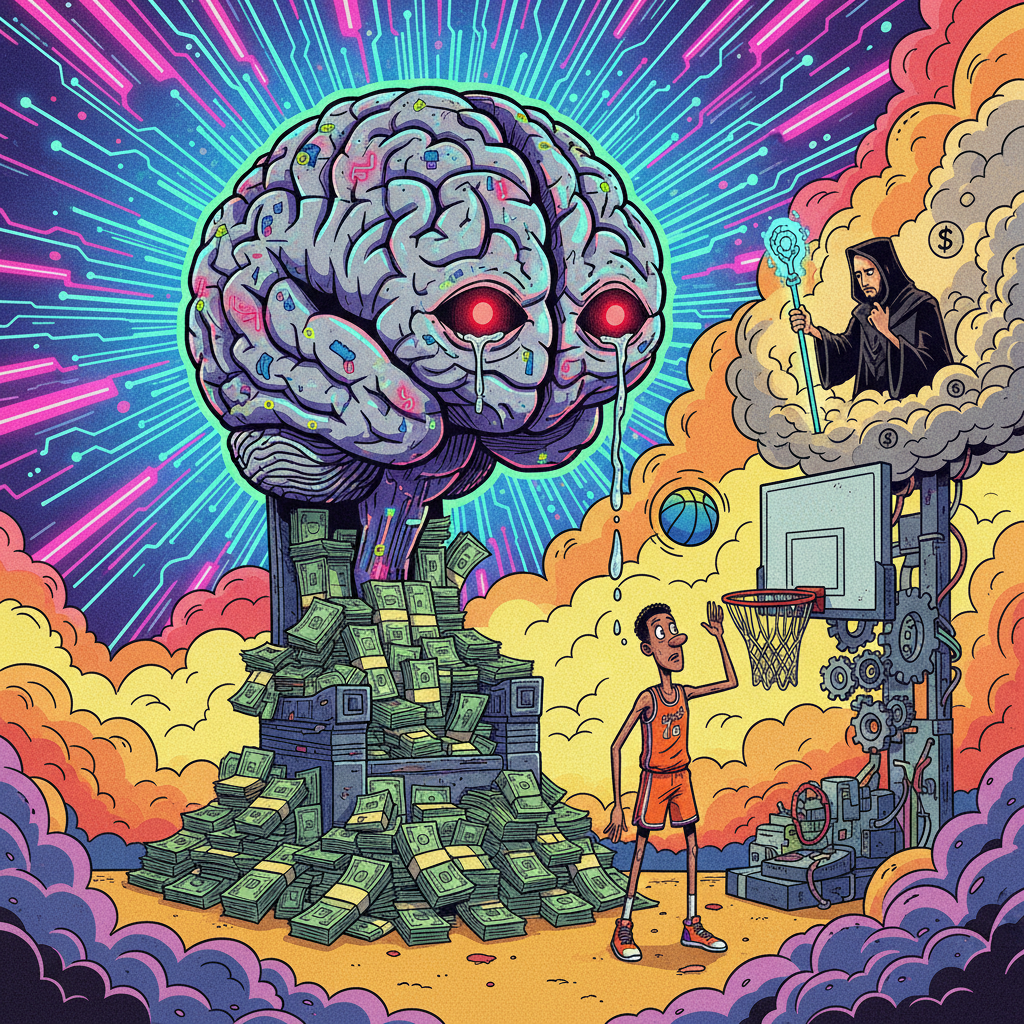
NEW YORK, NY — A groundbreaking report released today by the Institute for Advanced Computational Futilities (IACF) reveals that the sophisticated statistical models used to predict sports outcomes have officially surpassed the inherent complexity of the games themselves. Researchers found that the average algorithm employed by major betting platforms now contains more variables, conditional logic, and predictive analytics than the human body has functioning organs.
“We’ve reached a point where the models are not just predicting who wins, but why, how, and with what level of existential dread,” stated Dr. Evelyn Thorne, lead author of the study. “One model we examined for a routine college basketball game was so intricate, it accidentally started writing a philosophical treatise on the nature of free will and the illusion of choice, all while determining the over/under for three-pointers.”
The study highlights a growing trend where the pursuit of predictive certainty in sports has led to an arms race of computational power, often overshadowing the simple joy of watching athletes compete. “It’s no longer about whether the star player will perform; it’s about whether the neural network predicting his performance will achieve optimal convergence,” added Thorne. Industry insiders, speaking anonymously, confirmed that some models are now so advanced they occasionally predict future injuries before the players themselves are aware of them, leading to ethical dilemmas about pre-emptive benching.
One betting firm spokesperson, Chad ‘The Algorithm Whisperer’ Peterson, admitted, “Honestly, sometimes I just nod along. The models tell me Zion Williamson will score 28.7 points with a 63% probability, adjusted for lunar cycles and the emotional state of the opposing coach’s third cousin, and I just… input it. It’s less about sports and more about worshipping our silicon overlords now.”
The IACF concluded its report by suggesting that future sports events might just be simulated entirely by these models, rendering actual games redundant, and allowing fans to simply bet on the output of a server farm.