


WASHINGTON D.C. — A consortium of researchers from the National Institute of Advanced Hyper-Materials announced a groundbreaking discovery this week, identifying 'atomic distortions' within nickel-based compounds that could be directly linked to high-temperature superconductivity. Experts hailed the finding as a significant leap towards developing next-generation materials capable of conducting electricity with zero resistance—a capability currently achievable with conventional copper wiring, albeit with some resistance.
Dr. Quentin Flux, lead author of the study published in *Journal of Unnecessarily Complex Physics*, explained the implications. 'For decades, humanity has been plagued by the inherent inefficiencies of traditional electrical conductors, which, while highly effective for powering everything from your toaster to the national grid, still lose a minuscule fraction of energy as heat,' Flux stated. 'Our work on high-temperature superconductors, which must still be cooled to temperatures approaching absolute zero, aims to finally eliminate that negligible energy loss, fundamentally reshaping… well, something. Eventually.'
The new insights, which involved painstakingly observing picometer-scale vibrations in crystalline structures under conditions rarely found outside a vacuum chamber in a specific laboratory on Earth, are expected to pave the way for a future where energy transmission is theoretically perfect for applications yet to be conceived. 'Imagine a world where data centers operate with 0.0000001% less heat output, or where your phone charger is 100% efficient at turning electricity into… well, slightly more efficient electricity,' offered Dr. Brenda Capacitance, a senior researcher on the project. 'The possibilities, while not immediately impacting your monthly utility bill or the cost of avocado toast, are truly limitless in a very abstract sense.'
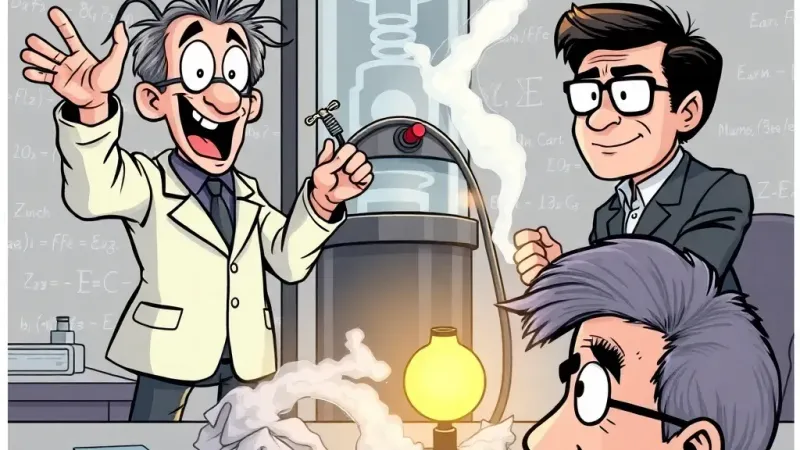
Critics of the multi-million-dollar research initiative argue that current energy challenges, such as grid stability, renewable energy storage, and the existential threat of rising sea levels, might benefit from more immediately actionable scientific endeavors. However, Dr. Flux dismissed such concerns, emphasizing the long-term vision. 'We're not just solving today's problems; we're solving the problems that our great-grandchildren's AI overlords will face when they need to transmit data perfectly across their Dyson Sphere,' he concluded, gesturing vaguely towards a whiteboard covered in equations and a crude drawing of a future city made entirely of light. 'Someone has to think that far ahead.'
Funding for the project is expected to continue for the foreseeable future, contingent on the scientific community's collective agreement that perfectly cold wires are indeed the most pressing issue facing the human race.