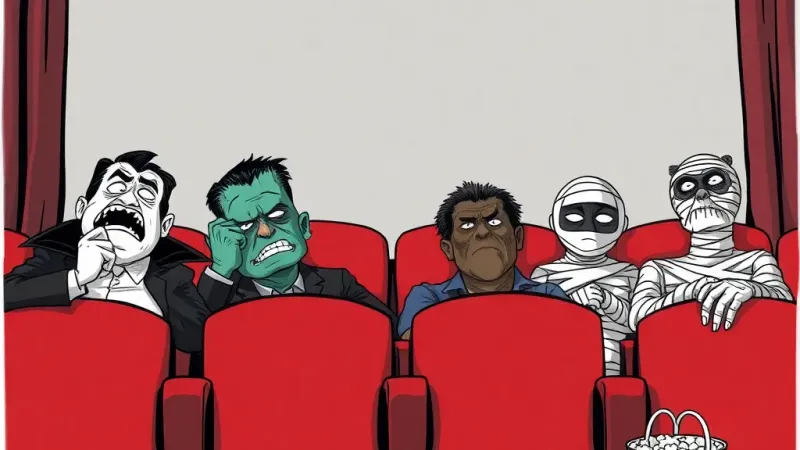
A new independent horror feature, "Midnight Slaughter Cruise," has inadvertently triggered an industry-wide discussion about the declining quality of authentically terrible cinema after failing to secure even ironic cult classic status. The film, widely panned for its predictable script, uninspired practical effects, and leaden performances, was reviewed by critics not as "so bad it's good," but simply "bad." This failure to achieve the revered "ironically watchable" tier has sent shockwaves through the B-movie appreciation community, who had anticipated a new contender for their midnight marathon playlists.
"For decades, true cinematic gold was found in films that wholeheartedly committed to their own shoddy premise," explained Dr. Evelyn Reed, a professor of Post-Irony Studies at Glendale Community College. "Think 'Plan 9 from Outer Space,' 'The Room,' or anything featuring a land shark. These new productions, they lack soul. They're not bad with passion; they're bad with a spreadsheet. It's a bland, inoffensive incompetence that manages to bore rather than entertain. There's no raw, unfiltered human error, just a carefully constructed approximation of it." Dr. Reed highlighted that genuine badness arises from earnest, misguided ambition, not from focus-grouped attempts at viral notoriety.
According to a recent report by the Institute for Foundational Fails, the average "intentionally bad" film now costs 35% more to produce than its genuinely incompetent predecessors from the 1980s, largely due to consultants specializing in "curated camp," "meta-bad pacing," and "pre-viral meme integration strategies." This over-engineering of mediocrity has led to a significant drop in authentic, accidental genius. Viewers, now accustomed to the deliberate chaos of TikTok shorts and algorithmically generated content, are increasingly discerning when it comes to feature-length incompetence. The subtle art of a truly awful jump scare or a line delivered with perfectly misplaced sincerity is being lost to producers aiming for 'marketable trash.'
"You can't just stumble into a cult classic anymore," lamented Lars Johansson, head of Acquisitions at 'The Deep Cut Dungeon,' a streaming service specializing in obscure cinema. "Our data shows audiences are 73% less likely to rewatch a film if its badness feels *engineered* rather than organically disastrous. There's a fundamental difference between a passion project gone wrong and a passion project that's been run through five focus groups to ensure it hits peak 'so bad it's good' metrics. It's like trying to perfectly recreate a natural disaster; it loses all its horrifying charm and unpredictable chaos. We're seeing a drought of films that genuinely surprise us with their ineptitude."
The unfortunate reality, say industry analysts, is that the era of the 'so bad it's good' classic might be drawing to a close. With production tools becoming more accessible and sophisticated, and the relentless pressure for content to be 'streamer-friendly,' true, unadulterated filmmaking ineptitude is becoming a rare commodity. It's replaced by a bland competence that satisfies no one, a cinematic uncanny valley where films are too bad to be good, but not bad enough to be legendary. The market for truly bizarre and earnest cinematic failures is drying up, leaving a void that even the most well-intentioned, poorly executed CGI monster cannot fill. The golden age of unintentional comedic horror appears to be firmly in the rearview mirror.
Critics now fear that future generations may never know the pure, unadulterated joy of genuinely terrible cinema.