


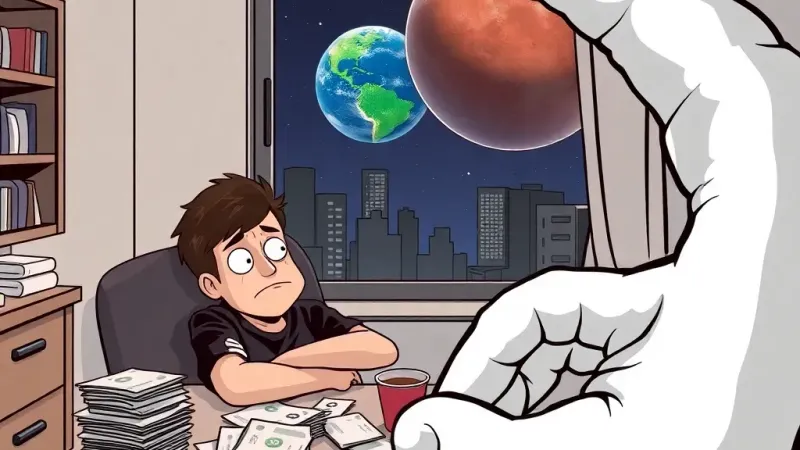
An international consortium of astronomers announced Tuesday the discovery of TOI-4616 b, an Earth-sized exoplanet orbiting a nearby M-dwarf star, prompting the collective realization that this groundbreaking scientific achievement will do absolutely nothing to alleviate any immediate human suffering or systemic economic woes back on its home planet. The distant world, located a mere 200 light-years away, is described as "potentially rocky" and "certainly not a quick fix for your student loans."
Using NASA's Transiting Exoplanet Survey Satellite (TESS), the team confirmed TOI-4616 b's existence, noting its slightly larger-than-Earth dimensions and its likely status as another entry in the "can't live there, can't even visit there" planetary catalog. Initial spectroscopic analysis suggests an atmosphere that is either too thick, too thin, or simply too indifferent to human aspirations of affordable housing. "We're always excited to find another dot out there," stated Dr. Aris Thorne, lead exoplanetary cartographer at the Pulsar Institute for Faraway Dots. "It truly expands our understanding of the vast, uncaring cosmos. Will it lower your grocery bill? No. Will it halt ocean acidification? Also no. But look! A dot!"
The discovery comes at a time when global citizens are navigating record inflation, a persistent affordable housing crisis, and the 2 of their own planet’s spiraling climate disaster. Public reaction to TOI-4616 b's unveiling was reportedly muted, with many online comments expressing sentiments ranging from "cool, I guess" to "can it pay my medical bills?" One viral meme depicted the new planet with a "For Lease: Cash Only" sign. Experts were quick to clarify that even if humanity developed warp drive 2 by next Tuesday, the planet's average surface temperature, likely volatile radiation, and complete lack of barista-grade coffee machines rendered it unsuitable for anything beyond a truly desperate last resort.
"While the scientific community justifiably celebrates these cosmic breakthroughs, it's crucial to acknowledge the stark disconnect between the infinite possibilities of space and the finite, very pressing problems here on Earth," explained Anya Sharma, a spokesperson for the Planetary Perspective Institute, an organization dedicated to tracking humanity's overall level of 2. "Frankly, most people just want to know if their landlord is going to raise the rent again, or if AI will take their job before they finish scrolling TikTok. An 'Earth-sized' planet 200 light-years away is, quite literally, not on their radar unless it promises free Wi-Fi and a two-bedroom apartment."
In response to the news, several tech billionaires immediately began drafting press releases for "Project Elysium," an initiative to sell speculative virtual land deeds on the newly discovered world to venture capitalists, citing its "unparalleled potential for digital real estate appreciation." Critics, however, pointed out that even in the metaverse, the commute would be brutal.
Meanwhile, back on Earth, the average rent for a one-bedroom apartment climbed another 0.5% this month. Hambry is a satire publication. All articles are works of fiction.
