
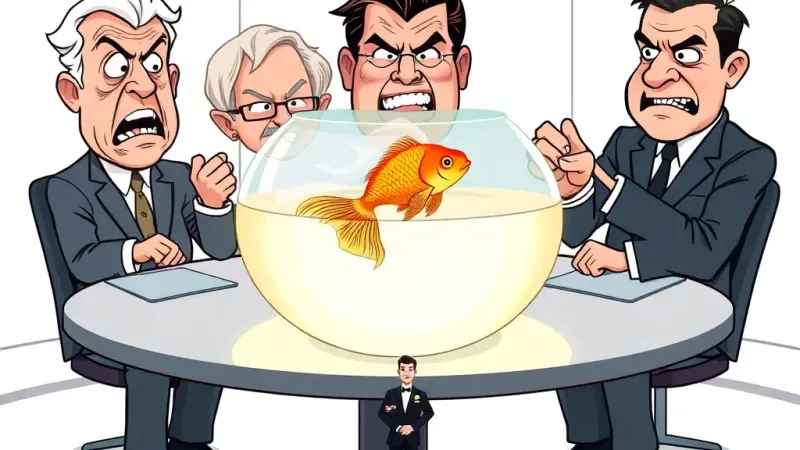
A new animated feature, "Fin-esse," has inadvertently ignited a robust international discourse concerning the ethical and legal complexities of inter-species 2, specifically focusing on its central plot point: the marriage between a human male and a sentient goldfish. The film, originally slated as a lighthearted romantic 2, has instead become an unexpected flashpoint for academic panels and think-tank white papers across multiple continents.
Early reviews, while acknowledging the film's "charming animation," have largely pivoted to existential inquiries regarding consent, species sovereignty, and the inherent power dynamics in a union where one partner requires an aquarium. Dr. Evelyn Reed, a bio-socio-cultural ethicist from the prestigious Pendergast Institute for Advanced Theoretical Jurisprudence, stated, "We can no longer dismiss these narratives as mere fantasy. Art imitates life, and increasingly, life imitates the most outlandish corners of our streaming queues. The film asks: what constitutes a 'valid' partnership when one party primarily communicates through undulating fins and an occasional bubble stream? And crucially, who gets the fishbowl in the divorce?"
The debate has already trickled down into more niche online communities, with several "aqua-romantic" forums reporting a significant uptick in membership and calls for broader recognition of non-traditional bonds. Legal scholars are reportedly drafting hypothetical amendments to existing marital statutes, considering clauses for "habitat compatibility" and "trophic level alignment." One proposed framework, seen by this publication, includes a mandatory "pre-nuptial ecosystem assessment" for all future human-aquatic unions.
Film studios, initially thrilled by the unexpected intellectual engagement, are now reportedly scrambling to develop a sequel, "Fin-esse 2: The Co-Parenting Challenge," which will delve into the complexities of raising amphibian-human hybrid children, provisionally titled "gill-kids." Producers hope to address the societal anxieties around integrating these "biologically unique" offspring into traditional school systems and local swim meets.
The film's director, Bartholomew "Buddy" Finn, whose previous credits include "Talking Toasters 3" and "My Best Friend's Imaginary Girlfriend," expressed surprise at the scholarly reaction. "I just thought it was a funny idea," Finn commented during a recent virtual panel on "The Post-Anthropocentric Future of Romance." "He loves her, she loves him. He keeps her tank clean. It’s simple. Honestly, the biggest challenge was animating her expressing emotion without a face."
Critics are now speculating whether "Fin-esse" will usher in a new era of "philosophical animation," where the viewing public is encouraged to engage with increasingly abstract and existentially challenging relationship paradigms. The Academy of Motion Picture Arts and Sciences is reportedly considering a new category for "Best Speculative Ethnographic Documentary (Animated)."
The real question remains whether society is ready to consider the legal implications of a union whose core domestic dispute might revolve around chlorine levels or the optimal pH for a healthy relationship.