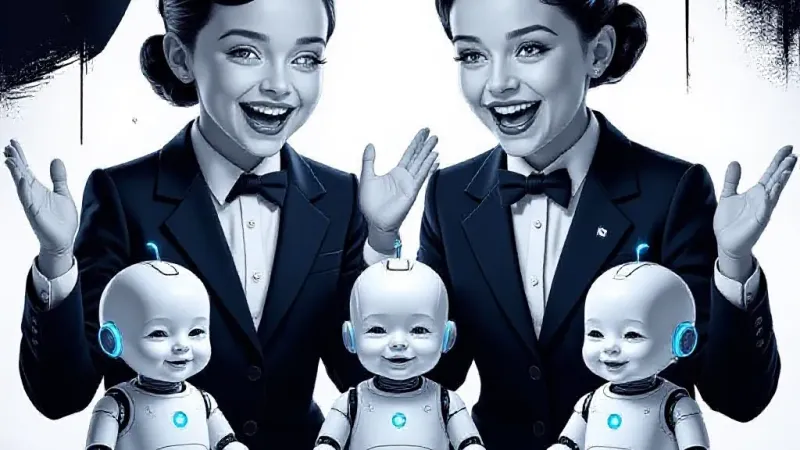
A new wave of artificial intelligence-powered "why" bots is being hailed by developmental psychologists as the crucial next step in optimizing early childhood language acquisition and critical thinking. Designed to field the incessant, often circuitous questions of young children, these AI companions promise to free up parental bandwidth while ensuring children receive "consistently accurate and emotionally neutral" information. The goal, according to creators, is to provide a scalable solution to the "conversational overhead" that has historically burdened human caregivers, making human parents the bottleneck.
"For too long, parents have been forced to engage in unstructured, often redundant dialogue with their offspring, leading to suboptimal information transfer and emotional fatigue," explained Dr. Evelyn Finch, Director of the Institute for Streamlined Human Interfacing (ISSHI). "Our new 'CurioBot 3000' ensures every child's inquiry, from 'why is the sky blue?' to 'why can't I have another cookie?', is met with a pre-vetted, algorithmically optimized response. This eliminates the emotional variability and logical inconsistencies inherent in human replies, laying a far more stable cognitive foundation. We're training children for a future where information is king, and emotions are merely processing errors."
Parents, meanwhile, are dedicating newfound time to their own personal growth and productivity metrics, unencumbered by the relentless demand for explanations. Sarah Jenkins, a mother of two in Plano, Texas, notes, "Before CurioBot, I'd spend hours explaining why the dog doesn't wear shoes, or why we can't buy a unicorn. Now, the bot handles it, and I can finally focus on my Peloton streaks, optimizing my self-care routine, and scaling my artisanal candle side-hustle. It's truly revolutionary for my mental load and overall life-work balance." Jenkins adds that her five-year-old now primarily communicates in short, factual statements, often prefaced with "Query registered: explain."
The tech, operating on a sophisticated neural network trained on over 300 million hours of recorded child-parent interactions and 100 terabytes of Wikipedia data, has proven remarkably effective. "Children quickly adapt to the bot’s unwavering logic and lack of judgment," stated a spokesperson for OmniMind Systems, CurioBot's developer. "They've learned that a simple 'why?' will yield a statistically probable, context-aware answer without the unpredictable variables of a parent being tired, annoyed, or, frankly, just making stuff up. The trust factor is off the charts." OmniMind is now developing a "Why Not?" companion bot for adolescents.
While some traditionalists express concerns about potential impacts on emotional bonding and spontaneous human interaction, ISSHI researchers dismiss these as "legacy anxieties." They point to data showing children exposed to "why" bots develop an advanced understanding of predictive text, database search functions, and the efficient compartmentalization of information. The future, they contend, isn't about messy, inefficient empathy, but about lean, actionable information delivery and a generation fully prepared for the AI-driven workforce.
Critics argue the bots might be creating an entire generation fluent in data retrieval but utterly baffled by the nuances of human eye contact, the concept of an unquantifiable feeling, or the simple joy of an illogical answer.