
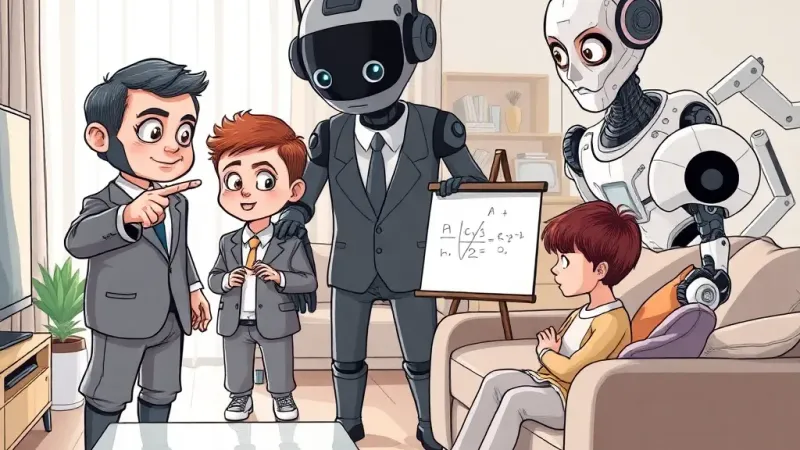
A new market research report from SNS Insider indicates the global smart AI toy market is set to exceed $55.23 billion by 2035, driven primarily by parents eager to delegate the more emotionally taxing aspects of child-rearing to advanced algorithms. The surge is attributed to the toys’ purported ability to handle sensitive discussions and provide consistent, non-judgmental feedback, freeing up parental units for other, presumably less onerous, tasks.
“We’re seeing a significant shift in the parenting landscape,” explained Dr. Evelyn Chen, a Senior Data Ethicist at the Institute for Optimized Childhood Outcomes (IOCO). “Modern parents are time-poor and often lack the specific training required for, say, explaining nuanced geopolitical conflicts or why Daddy sometimes just needs five minutes alone with his phone. Our 2 generation of ‘Parental Proxy’ units, like the popular ‘Cogni-Bot 3000’ or the ‘Pre-Therapy Pal,’ are designed to fill this critical relational gap, offering on-demand, procedurally generated empathy and age-appropriate rationalizations.” Dr. Chen noted that demand for units specializing in “Why Mommy Screamed at the Smart Speaker” protocols is particularly robust.
Industry insiders suggest this growth is less about enhanced learning and more about parental convenience. “Look, my kid asked me if robots would take all our jobs, and frankly, I was scrolling through TikTok and just pointed to the 'Existential Explainer 5.0' unit,” admitted Brenda Finkle, a mother of two from suburban Ohio. “It's programmed to provide a balanced, economically neutral perspective on automation and the future of labor. Much better than me stammering about transferable skills or something. And it doesn't judge my screen time.” Finkle added that the monthly subscription for customized moral guidance modules was a small price to pay for uninterrupted evening wine consumption.
Critics, mostly from defunct parenting blogs and academic departments nobody reads, express concern that outsourcing fundamental emotional development might have long-term societal implications. However, these concerns are largely dismissed by market analysts, who point to projected revenue streams. “The beauty of the AI toy market,” stated venture capitalist Miles Kempton of 'Kid-Tech Capital', “is that it monetizes a universal human truth: genuine emotional engagement is exhausting. Why waste precious human bandwidth when a sophisticated neural network can simulate a convincing semblance of care and deliver it with predictable ROI?” He added that the next frontier involves AI-driven “Grief Bots” capable of explaining pet deaths with perfect emotional modulation.
As the market expands, analysts anticipate the eventual development of ‘Parenting Protocol Bots,’ designed to teach human parents how to interact with their children’s AI companions.