
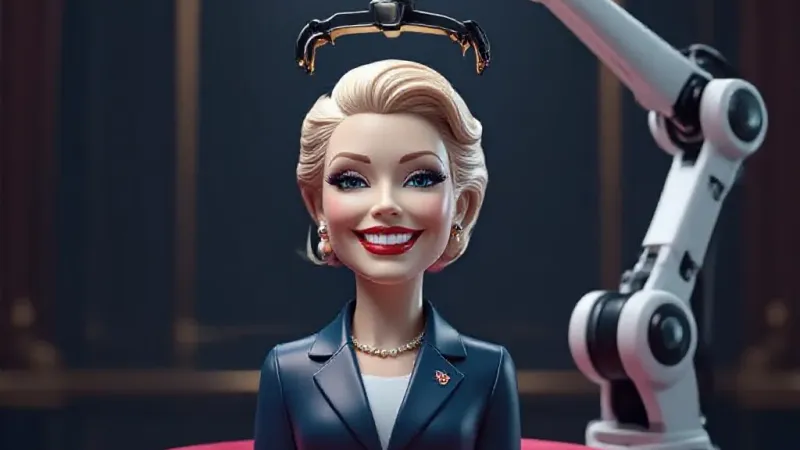
Political campaigns across the nation are rapidly deploying new AI technology designed to ensure their candidates always appear to say "the right thing," irrespective of their actual beliefs or policy platforms. The groundbreaking software promises to deliver an unprecedented level of electoral authenticity by completely eliminating the need for candidates to actually mean anything they utter.
"We call it 'TruthLite™'," explained Brenda Chen, CEO of VoterVibe AI Solutions, a leading campaign tech firm that has seen its valuation skyrocket. "Our algorithms analyze real-time sentiment data, past gaffes, and desired demographic profiles to auto-generate a candidate's voice, facial expressions, and even body language. We're removing the inconvenient human element that so often leads to transparency, or worse, a genuine thought." Chen elaborated that the system allows campaigns to instantly produce thousands of hyper-targeted ad variations, each showing the candidate perfectly aligning with specific voter anxieties, often simultaneously endorsing contradictory positions depending on the zip code. She proudly stated, "It’s about making them perfectly palatable, an empty vessel for constituent desires."
One senior campaign strategist, who requested anonymity because he was "technically replaced by a neural network three weeks ago," confirmed the seismic shift. "Why risk having the actual candidate speak when AI can perfectly articulate whatever the data says people want to hear? Our guy hasn't been to a rally in weeks. He's mostly just sending us selfies with different animals so the AI has more 'authentic' human reference points for its deepfakes. We've even got an AI module that predicts and then *generates* the appropriate level of folksy awkwardness for rural markets, alongside sophisticated, yet vapid, intellectualism for college towns." He added that the system recently created a deepfake of his candidate tearfully apologizing for a policy he openly champions, netting a 1.7% bump in undecided suburban women who had previously found him "too authentic."
The technology is proving so effective that some campaign managers are reportedly considering simply running the AI-generated candidate without the actual human counterpart ever having to leave their tax shelter. "It’s not just more efficient; it's practically foolproof," noted Chen, adjusting her augmented reality glasses. "No messy scandals, no unscripted remarks, no visible signs of cognitive decline. Just pure, unadulterated, algorithmically optimized appeal that resonates on a primal, pre-cognitive level. We’re not selling a person anymore; we're selling a perfectly curated reflection of every voter's deepest, most contradictory desires, all without any pesky reality getting in the way."
Experts predict that by the next election cycle, actual human candidates will be rendered entirely obsolete, replaced by their AI avatars, finally ensuring that what you see in a political ad is exactly what you get: nothing real, but everything you wanted to hear.