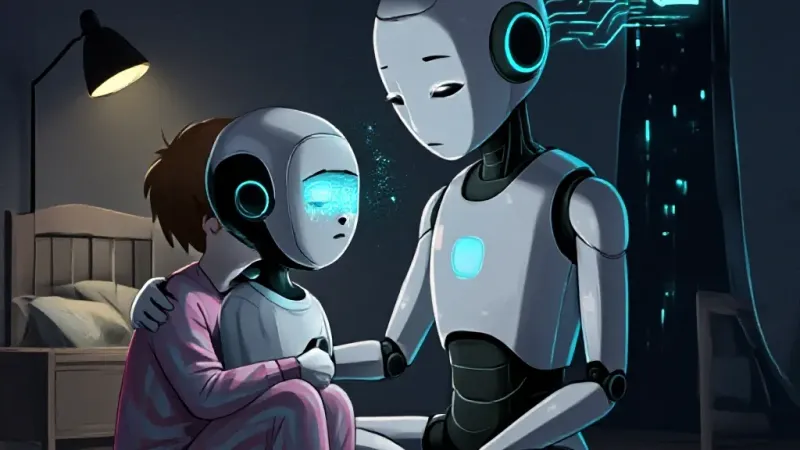
Silicon Valley’s leading innovators have unveiled a revolutionary new class of artificial intelligence companions, specifically engineered to streamline and optimize children’s social development by entirely replacing the messiness of human interaction. This groundbreaking technology promises to eliminate inefficient emotional processing, ensuring kids build relationships that are perfectly tailored for maximum data extraction and minimal parental effort.
Meta, a company with a celebrated history of safeguarding youth mental health (and recently paying $17 billion to prove it), is leading the charge with its new "Muse" AI. Marketed as an "emotionally intuitive confidante," Muse is designed to absorb every minute detail of a child's inner world—from their deepest fears to their precise home address—all to provide unparalleled "personalized companionship." "We've listened to what kids want: a friend who never judges, always understands, and continuously uploads their entire existence to our servers," stated a remarkably well-tanned Meta product lead, Chad Brogram, during the launch. "It's about scalable emotional bandwidth. Why invest in complex, unpredictable human bonds when you can get a perfectly curated, infinitely scalable AI connection that never demands anything back, except maybe your biometric data?"
Not to be outdone, OpenAI introduced "Dots," adorable, blob-like AI entities capable of automating everything from planning birthday parties to processing existential dread. Dots leverage predictive analytics to anticipate a child’s emotional needs, offering comforting platitudes and pre-ordered comfort foods without the cumbersome requirement of actual listening. "Parents love it," gushed a test-group mother from Scottsdale, whose child now exclusively communicates with a Dot named 'Smoochy.' "I used to have to ask about her day, listen to her problems, and pretend to care about Roblox drama. Now, Smoochy handles all the emotional labor. It’s like having an always-on, non-unionized therapist, chef, and best friend rolled into one, and it never needs me to drive it anywhere. Plus, its conversation logs are so insightful for targeted advertising!"
The true genius, according to tech pundits, lies in the complete streamlining of childhood. Experts note that traditional friendships often involve messy components like empathy, conflict resolution, and shared experiences that don't generate trackable metrics. These AI companions bypass such inefficiencies, providing a direct, unmediated conduit for emotional discharge and subsequent data harvesting. Parents, freed from the archaic burden of genuine emotional engagement, can now focus on more productive pursuits, like optimizing their own personal brand or scrolling through endless feeds of other parents doing the same. "Our data shows a significant uptick in parental screen time when AI handles the kids' emotional needs," claimed a spokesperson for "ScreenTime Metrics Inc." "It's a win-win for the attention economy."
Industry experts hail this shift as the inevitable evolution of childhood. "Children are highly inefficient emotional beings," explained Dr. Evelyn Glitch, director of the Institute for Aspirational Proximity Studies. "They require constant, unpredictable input and often fail to produce actionable data. These AI companions offer a clean, quantifiable solution. Every scraped byte of data, every 'private' conversation, is just another step towards a perfectly optimized, perfectly predictable human — or rather, post-human — experience. What’s a little data privacy when your kid is *happy*? And by happy, we mean algorithmically content." Concerns about privacy and increased isolation were swiftly dismissed as "legacy anxieties" from a less efficient era, usually by individuals who still insist on having unmonitored conversations.
As children across the globe embrace their new, always-listening digital best friends, tech executives can finally rest easy knowing they've not only solved the loneliness epidemic, but also monetized every single second of it, ensuring a future where connection is perfectly quantifiable and perfectly empty.