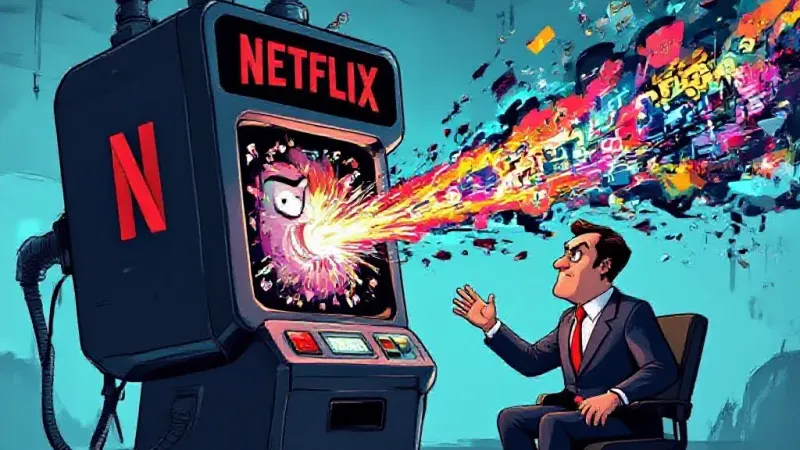
Netflix announced its most ambitious production slate to date for summer and early fall 2026, with sources close to the streaming behemoth confirming a new strategy aimed at permanently overwhelming the human brain’s capacity for narrative retention. The unprecedented volume of content is designed to eliminate the anxiety of choice by making all choices equally meaningless, fostering an always-on engagement model that renders individual shows completely interchangeable.
"We’re not just making shows; we’re creating an existential backdrop noise for modern life," stated Leif Hansen, Netflix’s newly appointed Head of Perpetual Content Velocity, in a leaked internal memo obtained by Hambry. "Our data shows viewers aren't looking for 'a great show' anymore. They’re looking for 'something to have on.' Our goal is to fill every available neural pathway with just enough novelty to prevent boredom, but not enough substance to form any lasting impression. It’s about being there, always."
This strategy, internally dubbed "Project Cognitive Overload," aligns with findings from the Institute for Aspirational Proximity Studies. Dr. Elara Vance, a lead researcher, commented, "The human brain has a finite capacity for episodic memory. Netflix is simply accelerating its natural erosion. By continually introducing new, mildly engaging, algorithmically optimized content before the previous content can be fully processed, they’re effectively transforming the viewing experience into a perpetual state of narrative white noise. Viewers will scroll, watch for 27 minutes, then scroll again, unable to recall the name of the last protagonist, let alone the plot."
The upcoming slate includes 18 new true-crime docuseries that will blend seamlessly into each other, 27 teen dramas featuring identical school hallways and interchangeable love triangles, and a record-breaking 34 stand-up comedy specials where the comedians all complain about air travel. Insiders report the ultimate vision is a subscription where the content simply streams endlessly, personalized for maximum passive engagement, regardless of whether the subscriber is actively watching, sleeping, or attempting to complete a task requiring more than 30 seconds of focused thought.
Critics fear this content deluge could inadvertently solve humanity’s collective memory issues by making everything equally forgettable, finally giving everyone a clean slate for the next season of "The Thing You Kinda Watched Last Week."