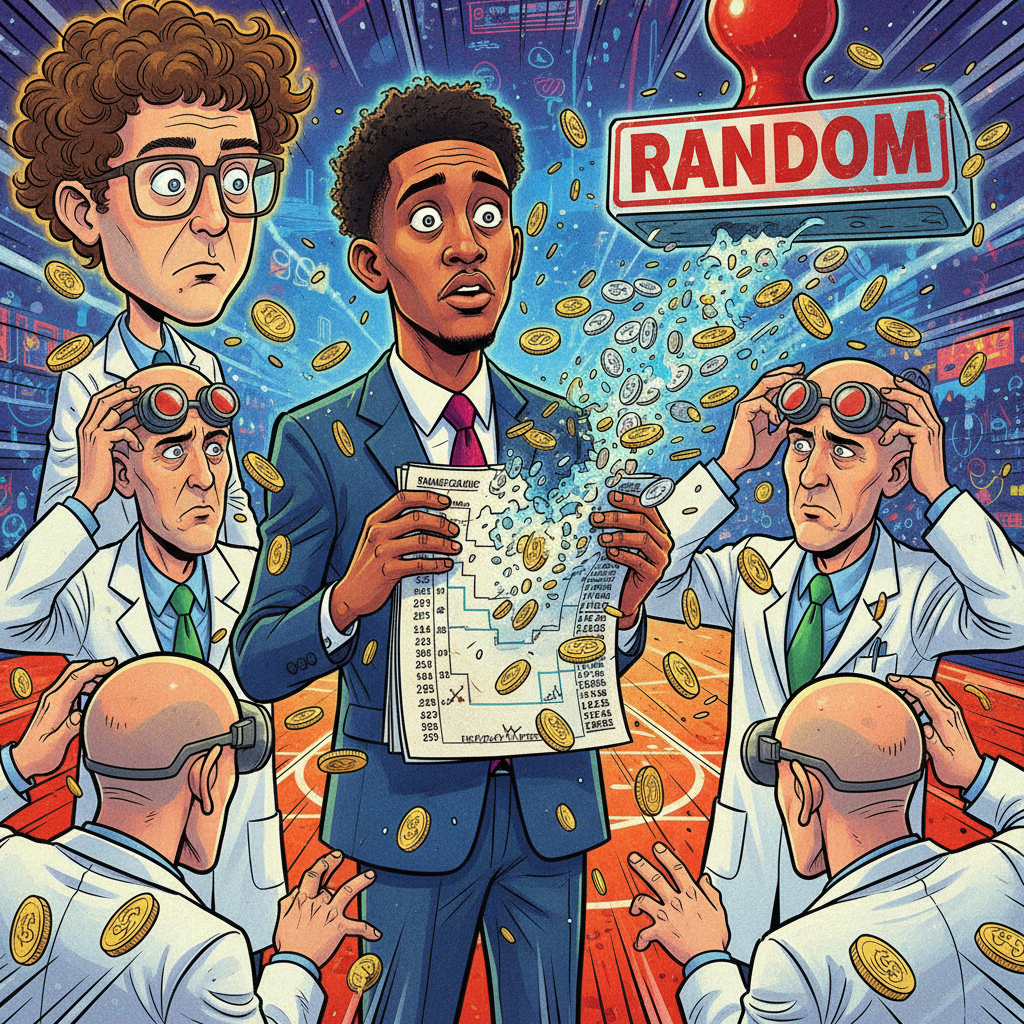
INDIANAPOLIS – In a groundbreaking study that promises to revolutionize how sports fans approach prognostication, researchers at the Institute for Advanced Probabilistic Anomalies (IAPA) have concluded that NBA All-Star Tyrese Haliburton’s highly publicized March Madness bracket for 2026 is statistically identical to a series of random coin tosses.
The analysis, which meticulously compared Haliburton’s picks against a baseline of purely arbitrary selections, found no significant deviation in accuracy, upset potential, or overall predictive power. “While Mr. Haliburton’s selections were certainly made with passion and a deep understanding of the game, our models show that his final bracket is, in essence, just as likely to be correct as if he’d simply thrown darts at a wall,” stated Dr. Evelyn Reed, lead statistician for the IAPA.
Sports networks, which had dedicated significant airtime to Haliburton’s “expert” insights, are now grappling with the implications. “We believed we were offering our viewers unparalleled access to a mind at the pinnacle of basketball,” said a spokesperson for a major sports broadcaster, who requested anonymity to discuss ongoing existential crises. “To learn it’s just… noise… it’s a lot to process. We might have to start interviewing actual coins.”
Haliburton, reached for comment, reportedly shrugged. “Look, I just picked who I thought would win. It’s March Madness. It’s chaos. What did they expect, a crystal ball?”
The IAPA is now turning its attention to other celebrity brackets, with preliminary findings suggesting that the entire concept of a “perfect bracket” might be a cruel, elaborate prank played by the universe.