
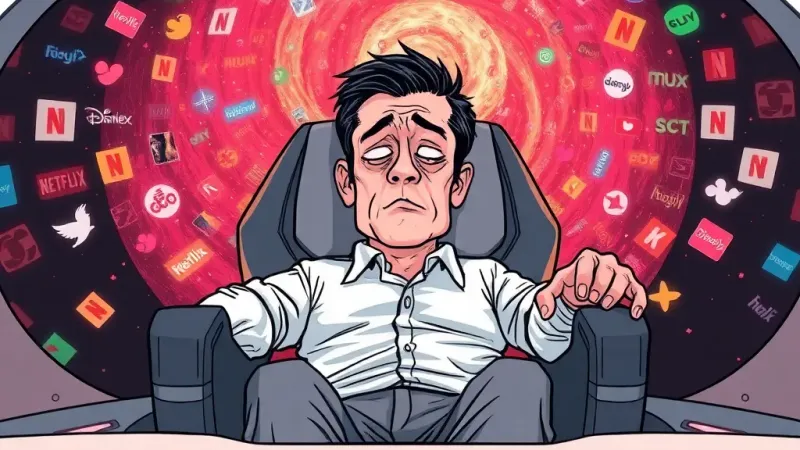
WASHINGTON D.C. — A groundbreaking study released today by the Institute for Digital Leisure Studies indicates that an unprecedented number of Americans are experiencing profound mental fatigue directly linked to the overwhelming task of choosing what to watch on streaming services. The report, titled "The Tyranny of Choice: When Entertainment Becomes Labor," found that the average viewer spends an estimated 42 minutes per session navigating menus, reading synopses, and consulting external recommendation lists before settling on—or often abandoning—their pursuit of content.
“We’ve observed a dramatic uptick in what we term 'Streaming-Induced Choice Paralysis (SICP) disorder,' where the sheer volume of options leads to cognitive overload, resulting in zero actual viewing,” stated Dr. Evelyn Reed, Director of Digital Leisure Studies and lead author of the report. “What was once a simple decision to flip on the television has morphed into a high-stakes, mentally draining curatorial endeavor. Our data shows that optimal Decision Fatigue Index (ODFI) scores are consistently breached by the time a user has scrolled past five rows of 'recommended for you' titles featuring actors they vaguely recognize.”
The economic implications are also staggering. Analysts at the firm McKinsey & Co. estimate that the national productivity loss from individuals deliberating over watching *another* superhero franchise prequel versus a prestige drama about sad rich people now exceeds the combined GDP of several small nations. “It’s not just the time spent scrolling; it’s the residual mental burden that spills over into actual work and social interactions,” said Bethany Croft, Lead Curation Strategist for one of the unnamed streaming giants. “Our data indicates that viewers are 37% more likely to ghost a casual dinner invite if they’ve spent more than an hour trying to decide between a German sci-fi series and a documentary about competitive cheese rolling.”
Media outlets, often complicit in this choice overload by publishing endless “must-watch” lists and “what’s streaming now” guides, are now pivoting to address the crisis they arguably helped create. *The New York Times*, for example, recently published a list of five sci-fi movies, a seemingly modest offering that sources suggest was the result of a six-month internal task force involving 14 senior editors and three external psychological consultants. Their goal: to provide just enough guidance to alleviate paralysis without fostering dependency, thereby maintaining subscriber engagement while simultaneously upholding their perceived cultural authority.
Ultimately, industry experts suggest that the future of content consumption may lie not in more choice, but in a radical shift towards algorithmic dictatorship, where the platform simply decides for you, eliminating the user’s burdensome responsibility to choose. Early trials show a 93% reduction in viewer anxiety, replaced entirely by a low-grade, persistent sense of being watched.