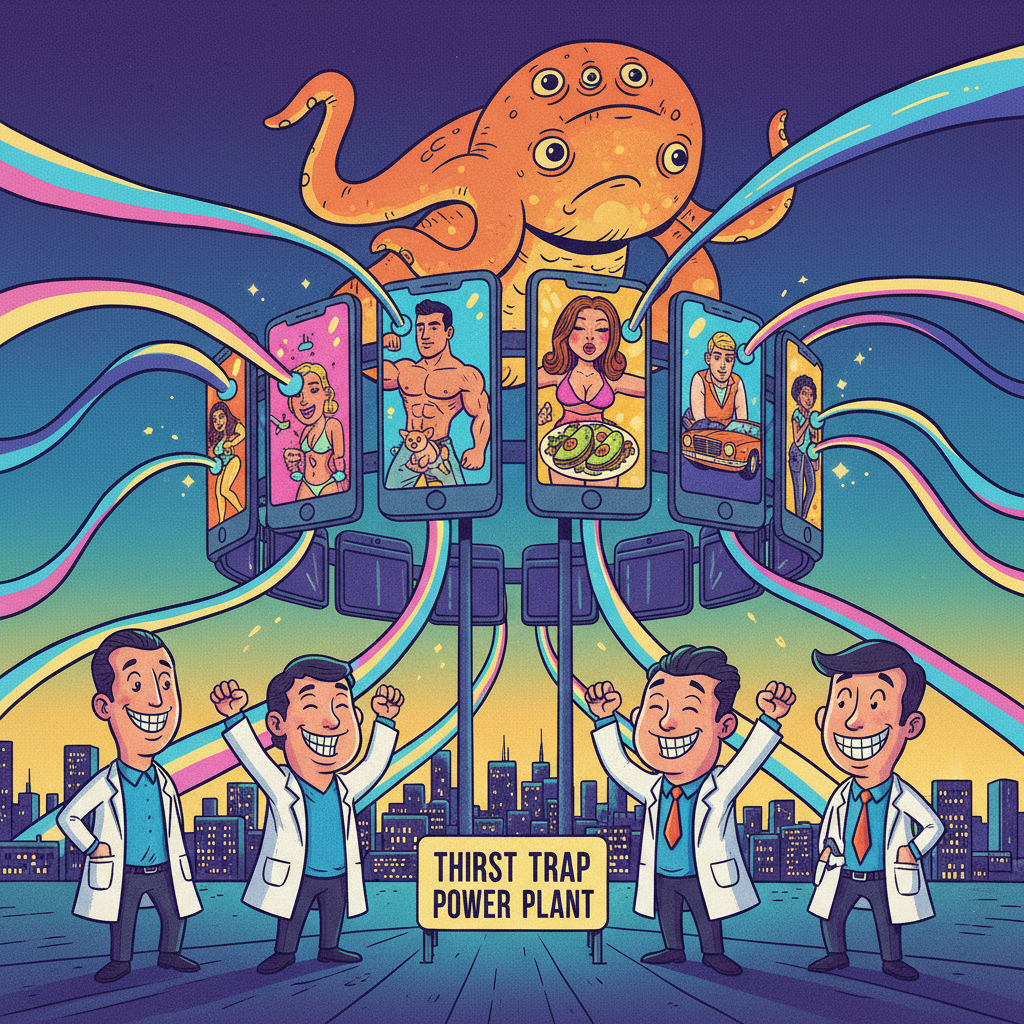
WASHINGTON D.C. – In a stunning development that could reshape global energy policy, a consortium of leading physicists and social media analysts announced today that the internet’s burgeoning supply of 'thirst traps' generates enough latent energy to meet the annual power demands of several developing nations.
The study, published in the peer-reviewed journal *Applied Digital Thermodynamics*, posits that the collective emotional and physiological responses evoked by these carefully curated online posts create a measurable energetic output. Researchers estimate that the sheer volume and consistent refresh rate of these digital lures could provide a stable, carbon-neutral power grid.
“We’ve been looking for clean energy solutions for decades, and it turns out the answer was right there, in everyone’s Instagram feed,” stated Dr. Evelyn Reed, lead author and head of the Institute for Quantum Social Dynamics. “The human desire for validation, when harnessed correctly, is an incredibly potent force. We just needed to figure out how to convert that collective ‘oof’ into kilowatts.”
Initial pilot programs are reportedly underway, with specialized 'Thirst Trap Farms' being constructed in data centers. These facilities are designed to optimize the viewing experience for maximum energetic yield, employing advanced algorithms to identify and amplify content with the highest 'thirst quotient.' Critics, however, question the ethical implications of monetizing human vanity.
“It’s not just about the likes anymore,” Dr. Reed added, adjusting her glasses. “It’s about lighting up homes. Suddenly, that selfie isn’t just a selfie; it’s a power plant.”