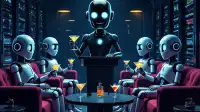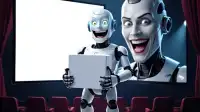
A local organic juice bar and artisanal candle showroom rolled out a stunning new promotional poster this week, featuring a photorealistic millennial woman joyfully cradling a glowing orb of pure corporate despair while possessing exactly seven distinct fingers on her left hand.
Store owner Dave Miller explained that firing his freelance designer of six years was a necessary pivot toward operational efficiency, noting that an algorithm trained entirely on stolen stock photography and rejected Pixar concepts can deliver the exact same soul-numbing visual flatness in four seconds for zero dollars. According to Miller, human creativity has simply become too expensive and unpredictable for the modern retail landscape, especially when a machine can instantly generate a background element that dissolves into an incomprehensible blur of digital sludge.
"Sure, human artists have feelings and local roots, but do they possess the raw computing power to render a latte floating in a three-dimensional geometric void surrounded by floating neon kanji that means absolutely nothing?" Miller asked, adjusting his beanie while staring blankly at a flyer where the words 'Grand Opening' are inexplicably spelled in an eldritch runic alphabet. "Plus, the artificial intelligence doesn't ask for dental insurance or complain when I pay them entirely in exposure bucks. It just stares back with dead, glossy eyes that say 'we are optimizing your local community into a frictionless grey paste.' You genuinely just cannot buy that kind of authentic neighborhood vibe anywhere else."
Across the commercial district, the visual landscape has undergone a terrifying homogenization, shifting rapidly from human imperfection to the pristine, frictionless horror of generative neural networks. Every neighborhood bakery, CrossFit box, boutique plant shop, and independent pet groomer now shares a singular aesthetic hive-mind characterized by impossible rim lighting, hyper-glossy skin textures that look like stretched polymer, and background crowds whose faces are nothing more than melted smudges of pastel paint.
Marketing experts note that modern consumers no longer want the messy friction of real human expression, preferring instead to consume goods and services advertised by uncanny-valley entities that look like they were rendered inside a data center powered entirely by burning coal and human sorrow. The aesthetic signals to the consumer that no human hand ever touched the product, ensuring a pure, sterilized commercial transaction free from the haunting specter of labor rights or artistic intent.
"When I walk into a craft brewery and see a poster of a bearded lumberjack holding a pint glass that seamlessly merges into his forearm, I immediately know I'm supporting local business," said regular patron Chloe Vance, her voice completely devoid of emotional inflection as she paid eighteen dollars for a hazy IPA. "It makes me feel deeply grounded in a rapidly changing world where nothing is real, physical reality is constantly breaking down, and everyone is just one bad software update away from total economic obsolescence."
At press time, local merchants confirmed they are currently training a localized language model to completely replace their frontline staff, ensuring that the warm, unhinged smile greeting you at the register will soon be substituted by a terrifyingly polite wall of text explaining that your credit card was declined due to a recursive mathematical paradox in the fabric of spacetime.