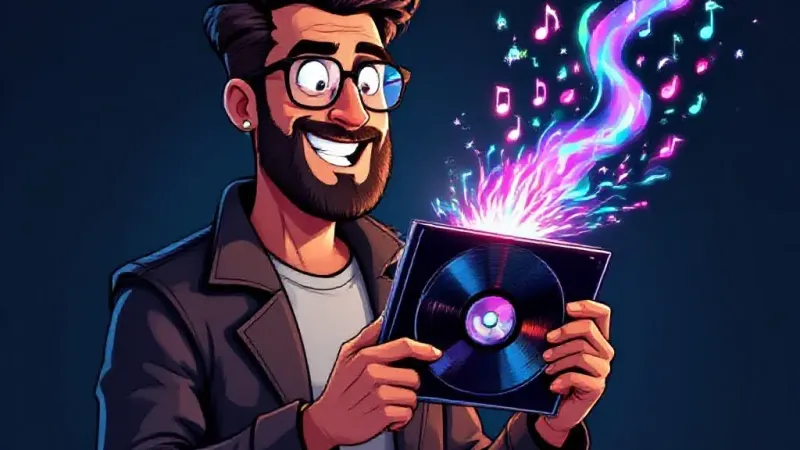
U.S. CD revenue has rocketed up nearly 60% in the first half of 2026, marking a powerful cultural statement from music fans eager to own something tangible before converting it into a file format they already had. Industry analysts are hailing the "retro tech boom" as a defiant stand against the ephemeral nature of streaming, largely ignoring the fact that most purchasers then immediately transfer the audio onto their phones for convenient, non-physical listening.
"There's just something about holding the music in your hand, you know?" explained Kaleigh "Kandy" Jenkins, 21, proudly displaying her newly purchased Olivia Rodrigo CD next to her Crosley record player, which is purely decorative. "I bought the CD, ripped it into iTunes — because who actually owns a CD player anymore? — then uploaded it to my Spotify library. It’s about the *ritual* of ownership. Plus, the jewel case looks amazing on my shelf, even if I never actually open it again." Jenkins added that the process makes her feel "more connected" to the artist, especially since she pays for the ad-free streaming tier.
Meanwhile, industry veterans are scrambling to meet demand for the shiny, fragile discs. "It's like people forgot about the joy of a scratched disc skipping, or misplacing the liner notes," mused Gary 'The G-Man' Gunderson, 68, CEO of 'Analog Dreams Inc.' which just pivoted from selling bespoke USB turntables to CD re-pressing. "We're seeing a lot of customers buy a CD, struggle to find a drive for their laptop, then just ask us if we can email them the album files instead. It’s beautiful. They still get the satisfaction of buying a physical object to then receive a digital download, just like in the old days."
Environmental groups expressed mild confusion over the sudden embrace of more single-use plastic, noting that the average CD has a shelf life of about 20 minutes before it's either scratched or its contents are liberated onto a hard drive. "We appreciate the nostalgia, but we're unclear why we're manufacturing millions of new coasters that eventually end up in a landfill, especially when the music is already freely available," stated Dr. Lena Patel of the Institute for Circular Consumption Studies. "It's like buying a brand new newspaper just to read the headlines on your phone."
The comeback, therefore, isn't really about the compact disc itself, but rather the powerful human desire to complicate simple processes and pay extra for the privilege of experiencing the same thing in a slightly more cumbersome way.