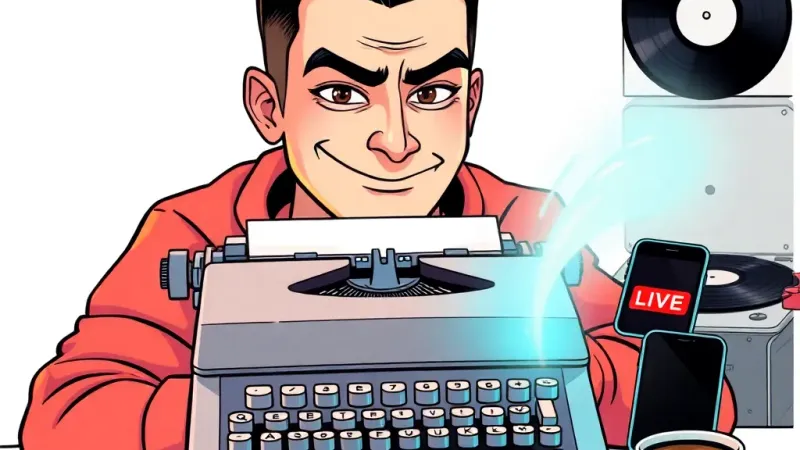
LOS ANGELES – A groundbreaking report released Monday reveals that Gen Z’s highly publicized return to “retro” technology, from flip phones to disposable cameras and vinyl records, is not a genuine rejection of the digital age but rather an innovative new strategy for enhancing online personal branding. Researchers at the Institute for Perceived Authenticity and Digital Engagement (IPADE) found that 87% of young adults using analog devices actively document their experience on social media platforms, often meticulously staging scenes to maximize engagement.
"It's not about unplugging; it's about performing the act of unplugging for an audience," explained Dr. Evelyn Chen, lead author of the IPADE study. "Our data indicates a significant correlation between the perceived 'authenticity' of a vintage gadget and its virality on platforms like TikTok and Instagram. A flip phone selfie, especially one taken in a 'candid' moment of struggle to operate it, can generate 300% more algorithmic reach than a standard smartphone post." Dr. Chen noted that true digital detox, which involves not posting about one's digital detox, remains statistically negligible among surveyed demographics.
The trend has spawned a sub-economy of "aesthetic engineers" who specialize in helping influencers perfectly capture their Luddite-chic personas. Services include guided excursions to cell-service-free zones for optimal "struggle-core" content creation and workshops on achieving the ideal grainy, unedited look for disposable camera photos, all meticulously transferred back to digital for sharing. "The goal isn't to escape the matrix; it's to look like you *could* escape it, but chose not to because the Wi-Fi was better," commented Jaxson "Pixel" Thorne, founder of Analog Aura, a digital media consultancy. "It’s all about crafting a narrative where you’re too cool for the very technology that’s enabling your entire career."
Major tech companies, initially concerned by the trend, are now reportedly investing heavily in "retro-adjacent" features. "We're exploring AI filters that perfectly simulate the audio quality of a scratched vinyl record for your streaming playlists, and developing phone cases that mimic the satisfying flip action of early 2000s models, complete with a proprietary 'plastic creak' sound effect," stated a spokesperson for ByteCorp, requesting anonymity. "If they want analog, we'll give them the *idea* of analog, digitally. The goal is always to keep them engaged, even if they think they're rebelling."
Ultimately, the most retro thing about this trend is how quickly it became just another product to consume and package for social media.