


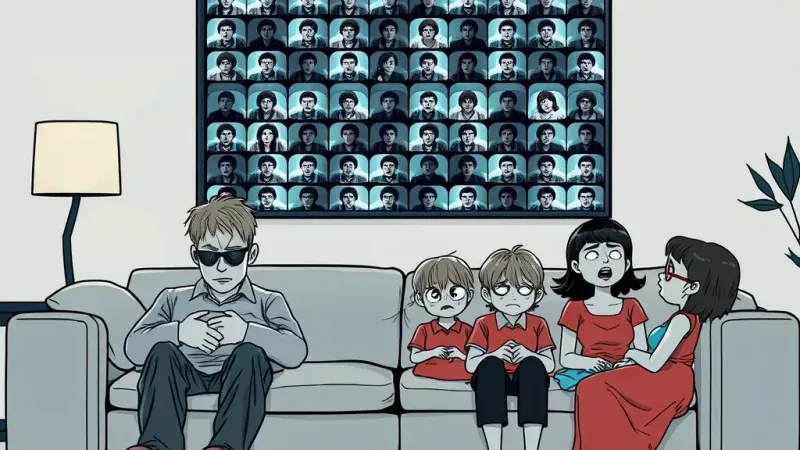
BURBANK, CA—In what financial analysts are calling a massive win for the American consumer’s relentless drive to own twenty-four distinct versions of the exact same content ecosystem, millions of households eagerly rushed this week to save up to 62 percent on a sprawling constellation of streaming services they will exclusively use to fall asleep on the couch while a true-crime documentary plays at forty percent volume.
The seasonal discounts, hitting digital storefronts just in time for families to avoid talking to one another during Thanksgiving, slash the combined monthly cost of acquiring every major media conglomerate’s proprietary app from the price of a used Honda Civic down to the slightly more manageable price of a monthly grocery bill. Industry leaders hailed the holiday rush as a triumphant return to the traditional American pastime of paying corporations for the privilege of watching ads we specifically bought subscriptions to avoid.
'We looked at what the modern consumer truly wants out of the holiday season, and the answer was clearly an agonizing matrix of tiered pricing models, ad-supported legacy tiers, and bundle-within-a-bundle architecture,' said Walt Disney Company executive vice president of digital subtraction Jeffrey Miller, adjusting his glasses while standing in front of a whiteboard that simply read *They Will Pay Whatever We Ask*. 'By offering a sixty-two percent discount on an annual commitment, we aren't just cutting prices—we are building a long-term psychological cage that ensures you will forget to cancel before the auto-renewal hits next November. That is the true magic of the season.'
According to consumer research firm Nielsen, the average American adult currently spends approximately four hours a day scrolling through algorithmic recommendation carousels designed by MIT graduates to induce a state of mild clinical dissociation. Users reportedly spend ninety percent of this time hovering over titles they have already seen three times, ninety-nine percent of the remaining time contemplating whether to start a prestige drama with a fourteen-episode commitment, and one percent actually watching a forty-minute YouTube video about a guy restoring a rusted anvil in a shed in Ohio.
Despite this, market analysts report that the promise of a Black Friday discount acts as a powerful hypnotic trigger, compelling sensible adults to sign up for four new streaming ecosystems featuring content libraries that consist entirely of four seasons of a cancelled procedural about a quirky medical examiner and sixteen different documentaries about the rise and fall of a disgraced cryptocurrency founder.
'I saw I could save twelve dollars a month if I bundled the sports app I don't use with the cartoon app I'm too old for and the prestige app that only streams subtitles in a minor Scandinavian dialect,' said local father and financial genius Greg Larson, 42, who spent four hours entering credit card information into a secure portal while his children stared blankly at a blank wall. 'Sure, I have to manage five different logins, remember three distinct parental control PINs, and agree to let a multi-trillion-dollar conglomerate sell my biometric eye-movement data to life insurance companies, but the savings are real. The math checks out. We're winning.'
Financial experts have noted that these promotional rates are carefully calibrated to expire precisely three days after the user loses their login credentials, triggering an automatic transition to standard billing rates that are fifty percent higher than what the service cost before the merger that created the conglomerate in the first place. This delicate economic choreography ensures that while consumers feel a brief, intoxicating rush of fiscal responsibility, the corporate balance sheets remain safely insulated from the devastating consequences of inflation, declining subscriber growth, and the catastrophic realization that nobody has made a good movie since 2004.
As millions of shoppers elbows-out their neighbors in digital checkout queues to secure their annual dose of consolidated intellectual property, cultural critics have pointed out that the modern streaming landscape has successfully recreated the exact cable television monopoly our parents spent twenty years trying to destroy, except now everything is twice as expensive, requires a high-speed fiber-optic connection, and crashes whenever a major sporting event occurs in a timezone two hours ahead of your own.
'We used to pay eighty dollars a month for five hundred channels of garbage,' said media historian Dr. Aris Thorne. 'Now we pay one hundred and twenty dollars a month for five applications that each contain three good shows, all of which were cancelled on a cliffhanger in 2019. Progress is truly an unstoppable march.'
At press time, sources confirmed that millions of subscribers had successfully activated their discounted bundles, immediately fired up the interface, and spent the next three hours reading plot summaries on Wikipedia before turning off the television to go scroll on their phones.