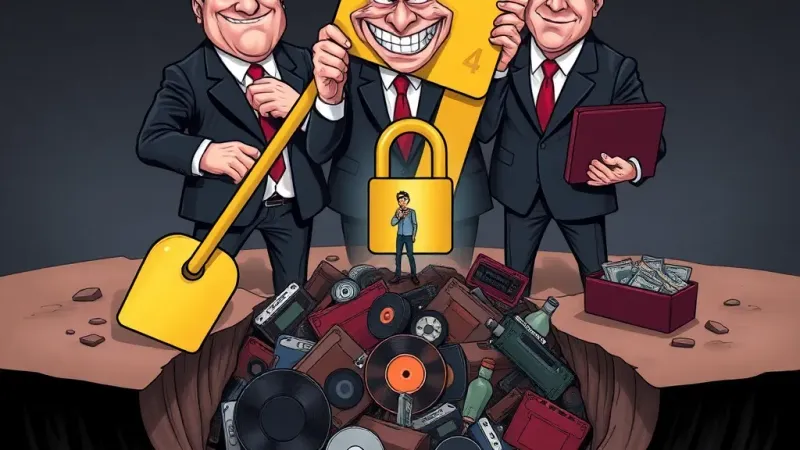
NEW YORK — A monumental digital archive, painstakingly compiled by a global network of volunteers who digitized over 10,000 live concert recordings from the private collection of a single, exceptionally dedicated fan, has been met with immediate and unified condemnation by major music labels. Industry titans have unilaterally declared the project a direct ‘threat to the creative economy’ and a perilous precedent for artist compensation, citing concerns over 'unlicensed public access' to decades of performance history.
Global SoundCorp CEO Randal Thorne issued an urgent press release today, asserting that while 'we profoundly appreciate the passion of fans who engage with our artists' work,' any unauthorized recordings represent 'billions in potential revenue diverted from the hands of hardworking artists and the sophisticated infrastructure that painstakingly supports and monetizes them.' Thorne further clarified, 'This isn't about stifling individual creative expression or community-driven preservation; it's about rigorously safeguarding the future of intellectual property in an era where every hum, every strum, every spontaneous crowd cheer, and even every single cough between songs is a potential micro-transactional data point we simply cannot afford to leave unexploited by those who lack the appropriate distribution licenses and intellectual property agreements. The sanctity of the artist's ownership must extend to every atmospheric photon captured at a live event.'
Dr. Elara Vance, a senior fellow at the Institute for Monocultural Preservation and lead consultant on digital asset securitization, explained the gravity of the situation. 'What we have here is a spontaneous, uncurated, and critically, *unpaywalled* aggregation of performance data,' Vance stated. 'This undermines the delicate balance of market-driven cultural dissemination. Every minute of free access potentially depreciates the perceived value of a similar minute available on licensed platforms, creating a slippery slope towards a dystopian future where consumers might expect content without direct transactional exchange.'
Meanwhile, sources close to the industry, speaking anonymously due to ongoing 'strategic re-evaluation protocols concerning emergent digital heritage aggregation,' admitted the actual concern lay less with the nominal past losses and significantly more with the pre-emptive capture of *future* revenue streams. 'Look, these tapes have been sitting in a guy's basement for decades, gathering literal dust,' one source, a senior consultant at a firm specializing in 'unbundling latent cultural assets,' confessed. 'Nobody cared about these until they were organized, curated, and, crucially, made accessible. Now that they're a coherent, searchable database, it's not just a collection; it's a new asset class. Our immediate priority is to understand how to put a tiered subscription model on it, or perhaps tokenize individual 'rare performance moments' into blockchain-verified concert moment NFTs. The 'threat,' frankly, is that someone else got there first and made it... freely public, before we could implement a value-capture framework.'
Industry analysts predict that within six months, the 'unauthorized archive' will either be fully acquired and rebranded as 'Artisan Heritage Vault Premium,' or buried under a mountain of cease-and-desist orders so vast it will form its own digital archaeological site.