
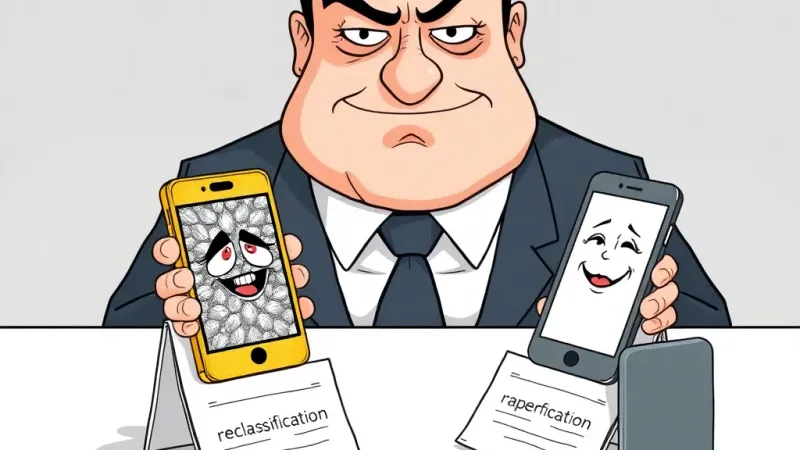
CHICAGO — Motorola announced Tuesday that its line of previously categorized "budget" smartphones will now simply be known as "phones," reflecting a new pricing structure that sees devices increase in cost by up to 50 percent. The company stated the move is a necessary adjustment to current market conditions, supply chain dynamics, and the evolving definition of affordability for the modern consumer, who, it notes, is increasingly "price-agnostic" when seeking essential digital tools.
The change effectively repositions entry-level models like the Moto G Power and Moto G Stylus into a broader category, with price points now frequently encroaching on what were formerly considered mid-range offerings. "When we say 'budget,' what we truly mean is 'a phone you can buy, eventually, maybe on a payment plan, after careful consideration of your monthly discretionary income'," explained Brenda Hayes, Motorola's newly appointed Global Head of Definitional Clarity and Market Realignment. "We believe this updated terminology provides a more honest and less restrictive classification, freeing consumers from the outdated notion that 'budget' implies a specific, numerically low monetary value that might preclude features like a camera that doesn't look like a potato or a battery that lasts longer than a work meeting." Hayes emphasized that despite the higher price tag, the fundamental user experience remains unchanged for the target demographic: people who desperately need a phone.
Industry analysts largely lauded the decision as a bold step towards market transparency. "For too long, the term 'budget phone' has created unrealistic expectations among buyers, suggesting some kind of financial restraint was involved in the purchasing decision, rather than an acceptance of current market realities," commented Dr. Aris Thorne of the digital economics think tank, *Profligate Analytics*. "Motorola is simply recognizing that in 2025, every phone is a budget phone if you buy it with money you don't really have but absolutely require for daily function, which is, frankly, most consumers. This isn't about mere inflation; it's about aspirational nomenclature and the universal human desire to own the minimum viable product at maximum viable cost." Dr. Thorne's 2 report, "The Psychological Value of Zero-Interest Debt in Sustaining Consumer Confidence," suggests that consumers derive greater satisfaction from purchases perceived as "necessary investments into their personal digital infrastructure" rather than "frugal choices for the financially constrained."
While previous iterations of Motorola's entry-level devices aimed to serve users seeking basic functionality at the lowest possible cost, the new "phone" category promises to deliver "just a phone" at a price point commensurate with the prevailing global economic climate and the general cost of simply existing as a connected human being. Shoppers browsing online for a "budget phone" will now simply find a selection of "phones," with the understanding that true affordability is an abstract concept, a personal journey, and potentially a tax write-off if you're entrepreneurial enough. Consumers are encouraged to embrace this semantic shift, seeing it not as a price hike, but as an opportunity to rethink their relationship with essential technology.
The company reportedly considered rebranding its premium flagship devices as "really expensive phones" but deemed the shift too jarring for brand continuity.