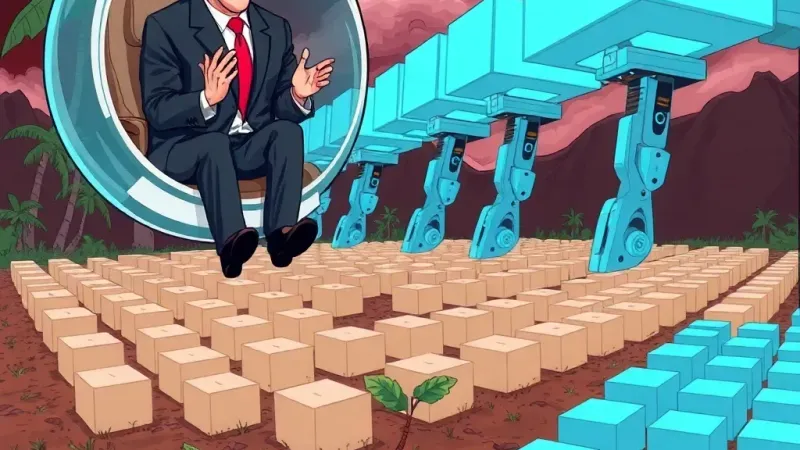
HONOLULU — A Silicon Valley-based agri-tech firm, HarvestAI Solutions, has unveiled an ambitious plan to completely overhaul Hawaii's food system, proposing a "data-driven, AI-optimized nutrient delivery platform" to enhance local food security. The initiative, presented by a consortium of non-local experts and venture capitalists, promises to eliminate food waste, maximize caloric output, and achieve 100% food self-sufficiency through proprietary algorithms and robotics.
According to a white paper released by HarvestAI, the new system, dubbed "Project ManaFeed," will transition existing agricultural lands into highly efficient, automated vertical farms and aquaculture facilities. These facilities will be managed by a central AI, "AgriMind 7.0," capable of monitoring crop health, predicting optimal harvest times, and adjusting soil composition in real-time. "Our solution will replace the antiquated concepts of 'soil' and 'weather' with predictable, algorithmically controlled environments, guaranteeing consistent yields regardless of natural variability," stated Dr. Elias Thorne, CEO of HarvestAI, in a virtual press conference from his 2 office.
The firm claims its approach will reduce Hawaii’s reliance on imported food by a projected 98.7% within five years, primarily by focusing on high-density, nutrient-rich staples like lab-grown algae and genetically optimized soy variants. Traditional crops, deemed “sub-optimal for modern nutritional matrices,” are expected to be phased out in favor of these more efficient alternatives. “Think of it as defragmenting a hard drive,” Dr. Thorne explained. “We’re taking all the messy, inefficient sectors of traditional farming and optimizing them for peak performance and caloric throughput.”
Local reactions to Project ManaFeed have been mixed. "They want to replace our taro patches with glowing vats of 'optimized protein sludge,'" remarked Malia Kekoa, a fourth-generation taro farmer from Oahu. "They say it's about food security, but it feels more like an eviction notice from people who think a spreadsheet can grow a community." Kekoa's concerns, echoed by numerous indigenous farming collectives and cultural preservation groups, suggest a potential disconnect between technological efficiency and deeply ingrained cultural practices.
HarvestAI Solutions, however, remains confident, emphasizing the project's scalability and potential for significant return on investment. The company projects initial funding will come from a mix of private equity and a new blockchain-based carbon credit offset scheme, allowing global investors to "participate in Hawaii's sustainable food future."
Critics point out that HarvestAI's proposal contains no mention of local employment, cultural impact, or the actual taste of the proposed food products, which Dr. Thorne dismissed as "legacy concerns that don't scale."