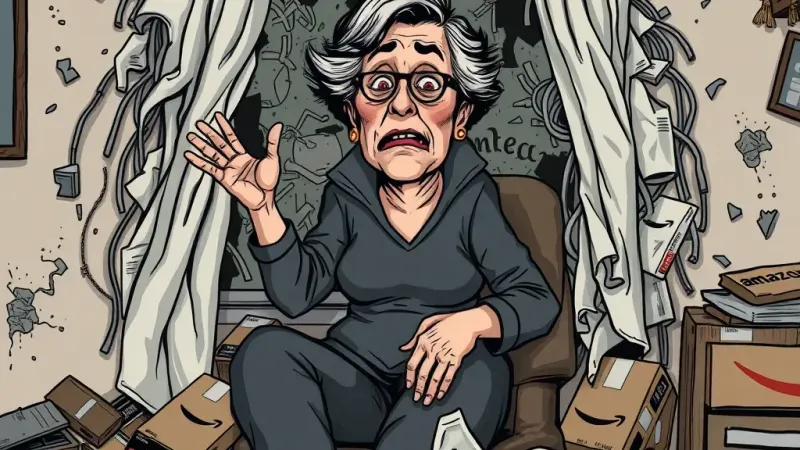
DENVER—Locally residing financial hostage and modern homemaking enthusiast Chloe Vance reportedly achieved the long-sought-after aesthetic of old-money wealth this weekend by spending an exhausting, soul-crushing fourteen hours gluing discount synthetic polyester strips, two rolls of industrial duct tape, and several crushed Mountain Dew cans to her living room window frame.
According to Vance, whose apartment smells faintly of hot glue fumes and simmering despair, the transformation was achieved entirely through a revolutionary $15 hack she discovered on a lifestyle blog titled Living Large While Completely Broke. The technique, which requires absolute silence, three blistered index fingers, and a total detachment from one’s remaining dignity, effectively tricks anyone standing more than twelve feet away into believing the occupant can afford curtains that do not originate from a clearance bin at a failing big-box retailer.
"When people walk into my apartment, I want them to immediately assume I inherited a modest estate in Connecticut and not that I spend forty-five hours a week managing spreadsheet macros for a logistics firm that pays me in pizza parties," said Vance, adjusting a makeshift valence held together entirely by sheer willpower and a prayer to the Federal Reserve. "Sure, if you touch them, they feel like the lining of a discount Halloween costume, and yes, opening the window now requires a crowbar and a permit from the city. But from across the room, under very dim lighting, they look just like the kind of window treatments you would see in a digital catalog for a lifestyle brand targeted exclusively at venture capitalists."
The tutorial, which has already garnered millions of views online, is part of a rapidly growing genre of digital content designed to help the working class cope with late-stage economic stagnation through elaborate arts-and-crafts projects. Rather than addressing stagnant wages, skyrocketing rent, or the terrifying reality of a housing market that views basic shelter as an asset class for multinational hedge funds, lifestyle influencers have pivoted aggressively toward teaching wage laborers how to make plastic grocery bags look like artisanal silk drapes using only a hair dryer and a staple gun.
Industry analysts point out that these DIY hacks serve a vital macroeconomic function by providing consumers with a frantic, productivity-obsessed hobby that distracts them from the total impossibility of ever purchasing real estate. By focusing intensely on the precise angle of a pleat or the optimal shade of beige acrylic paint, a generation of adults can successfully redirect their existential dread into a localized crafting emergency.
"We are seeing a fascinating cultural shift where people no longer desire actual luxury, because actual luxury is entirely out of reach," explained cultural sociologist Dr. Harrison Vance. "Instead, people are pursuing the theatrical performance of wealth. They want the aesthetic without the pesky underlying capital. If you can make a piece of cardboard look vaguely like crown molding using plaster of Paris and three tubes of caulk, you have successfully decoupled your self-worth from your bank account balance."
Vance remains unfazed by critics who point out that her hands are permanently fused together by industrial adhesive and that the curtains catch fire every time she turns on her apartment's radiator. She plans to tackle her next budget-friendly home transformation this coming weekend, where she intends to use discarded receipt paper and a tub of spackle to create a bespoke marble kitchen island that will undoubtedly collapse under the weight of a single piece of fruit.