
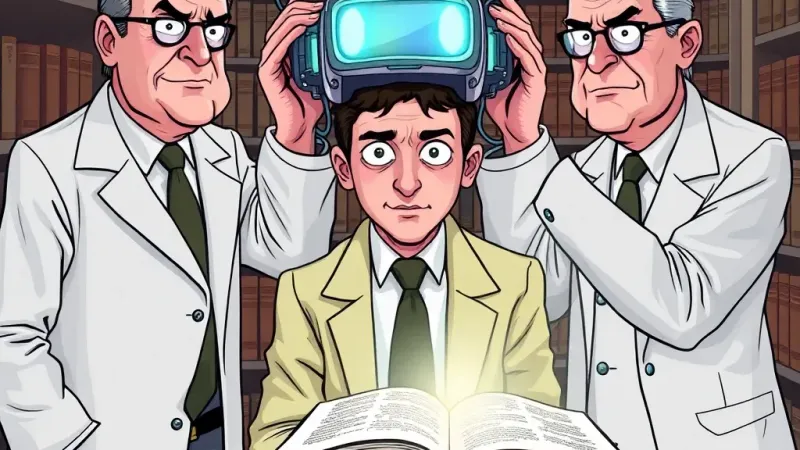
NEW YORK, NY – Literary scholars and cultural preservationists have collaborated on a groundbreaking "Classic Sci-Fi Patch," a digital overlay designed to help contemporary readers navigate the often-jarring social and technological landscapes of foundational science fiction works. The initiative, led by the Intergalactic Humanities Department at the University of Applied Fiction, aims to make seminal texts from authors like Robert A. Heinlein, Isaac Asimov, and Arthur C. Clarke accessible to new generations without requiring extensive personal re-evaluation of mid-20th-century cultural norms.
"We found that many students were encountering significant friction, not with the advanced theoretical physics, but with, for example, the casual sexism or the bafflingly inaccurate predictions about domestic technology," explained Dr. Evelyn Reed, lead cultural architect for the project, during a press conference held via a holographic projection. "This patch doesn't rewrite the text; it subtly recontextualizes it in real-time, preventing the reader from, say, screaming 'but why does the maid robot need to be *sexy*?' every other page."
The "Classic Sci-Fi Patch 1.0," currently in beta testing, employs a proprietary neural network to identify and, where necessary, redact or provide immediate clarifying footnotes for problematic terminology, anachronistic gender roles, and utopian visions that inexplicably omit public transportation. Early iterations struggled, occasionally replacing all instances of "rocket ship" with "electric scooter," but developers assure the public that the current version is finely tuned to enhance readability without altering authorial intent beyond repair. "Our goal is seamless integration," added Reed. "Readers should feel like they're enjoying a vision of the future, not a historical document that requires a PhD in anthropology to parse."
Publishing houses are reportedly exploring options to integrate the patch directly into e-readers and audiobooks, potentially offering a "legacy mode" for those who prefer their classics unfiltered, warts and all. "The market research is clear," stated Bartholomew 'Barty' Finch, Head of Reader Experience at OmniLit Press. "Younger audiences just don't have the stomach for a six-page monologue about the inherent superiority of male logic or how inconvenient it is that women keep wanting to vote. We're in the entertainment business, not the historical trauma business."
The development team hopes the patch will foster a renewed appreciation for these works, allowing readers to marvel at the narrative ingenuity without the constant need for internal fact-checking or emotional labor. However, some critics argue the patch sterilizes the historical context. "If you can't handle Heinlein's casual endorsement of forced sterilization, you probably shouldn't be reading Heinlein," argued Professor Kaelen Thorne, an independent scholar known for his unyielding purism. "The discomfort is the point; it's how you realize how far, or how little, we've come."
Ultimately, the initiative reflects a broader societal challenge: how to consume the media of the past when the present demands constant vigilance against anything that might, however inadvertently, cause a momentary grimace. Soon, students will be able to journey to the Moon without encountering a single instance of unsolicited commentary on a female character's figure, leaving them free to ponder only the truly terrifying aspects of humanity's future, like mandatory subscription services for breathable air.