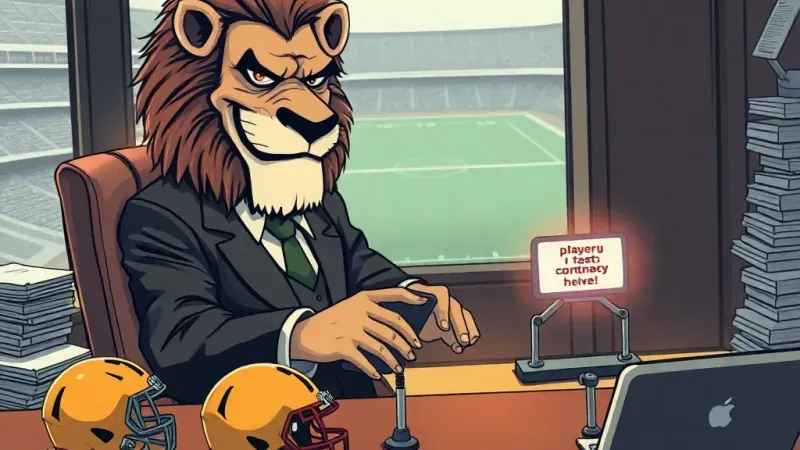
Detroit, MI – The Detroit Lions organization has officially acknowledged what many in the 2 have long suspected, confirming that its innovative player relations strategy includes a proactive "ghosting" protocol for certain personnel. This groundbreaking approach, detailed in an internal memo obtained by Hambry, aims to reduce "unnecessary friction" and "emotional labor" for front office staff when facing difficult personnel decisions or contractual impasses.
"Look, it's 2025. We're past the days of uncomfortable phone calls or email chains filled with polite but firm rejections," stated Ms. Brenda Thorne, the newly appointed Director of Player Emotional Ecosystems, in a rare public statement. "If a player or their agent isn't getting a response after, say, the third or fourth outreach attempt, it's safe to assume we've moved on. It's really about respecting everyone's time and mental bandwidth, especially ours." Thorne emphasized that the silent treatment is a "mutually beneficial" strategy, allowing players to "read between the lines" and infer the team's intentions without the stress of direct confrontation.
The internal memo, titled "Operationalizing Strategic Disengagement: A Modern Approach to Roster Management," outlined various tiers of "player communication disengagement." These ranged from a simple "unopened message status" for practice squad hopefuls to a more sophisticated "strategic non-reply with delayed 2 unfollow and accidental agent block" for veteran free agents. Analytics presented within the document showed a significant decrease in "awkward conversations per quarter" (down 32.7%) and a corresponding uptick in "staff well-being metrics" (a 12.4% increase in front office "vibe scores") since the pilot program's inception last season. The team also reported an 18% reduction in "agent-initiated follow-up calls" due to the sheer futility of continued outreach.
Sources close to the organization indicate that All-Pro offensive tackle Taylor Decker, whose recent inquiries about contract extensions reportedly went unanswered for weeks, was an early beneficiary of the advanced "soft-disconnect" technique. "Taylor's a professional," a senior Lions official, speaking on condition of anonymity, told Hambry. "He knows what it means when his calls go straight to voicemail and his texts show two gray checks. We trust our guys to be intuitive. We're not holding their hand through every step of their career dissolution." The official added that this method fosters a healthier, more independent athlete ecosystem by preventing "unhealthy attachments" to their current team.
Sports analysts have largely praised the Lions for their transparency in admitting to the strategy, though some questioned its long-term impact on team morale. "Finally, a franchise just says what everyone's doing anyway," commented noted sports psychology pundit Dr. Skip 'The Empathizer' Harrison on ESPN's *First Take*, gesturing wildly. "It's about setting boundaries. You can't expect the GM to be your emotional support animal. Sometimes, the most powerful communication is no communication at all." Harrison speculated that other teams, traditionally reliant on outdated practices like "exit interviews" or "courtesy calls," might soon adopt similar "digital distancing" policies.
The Lions are reportedly exploring a "mutual unfollow" clause for future contracts, ensuring a clean break on all digital platforms the moment a player is released or becomes emotionally inconvenient.