
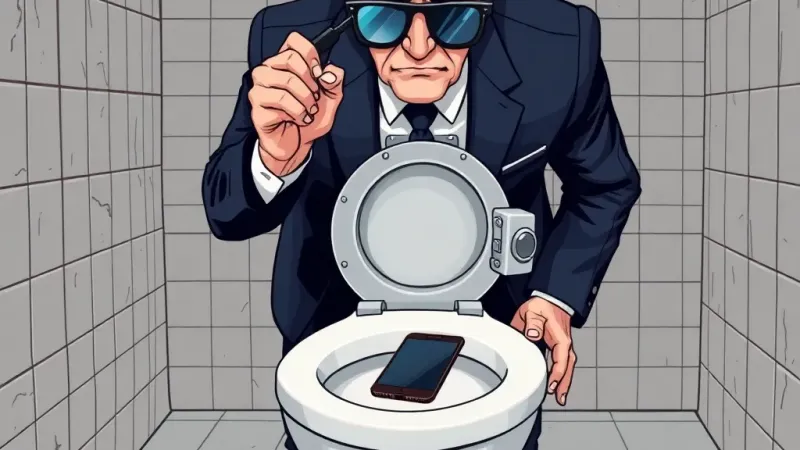
WASHINGTON D.C. — The Federal Bureau of Investigation announced Tuesday it has successfully accessed encrypted communications from the popular Signal messaging application, clarifying that the groundbreaking "vulnerability" exploited was, in fact, the target's physical proximity to their unlocked device. The Bureau emphasized that Signal's vaunted end-to-end encryption remains entirely uncompromised; the true weak point lies exclusively between the user's hand and their pocket, particularly when a public restroom is involved or, more broadly, whenever a powerful individual assumes basic security protocols apply to "other people."
"Our highly sophisticated recovery techniques involved observing a high-value target depart a private jet's lavatory without their phone, which was then retrieved from the porcelain fixture approximately 37 seconds later," explained Special Agent Rex Dynamo of the FBI's newly formed Analogue Data Acquisition Task Force. "It turns out the most advanced encryption protocols are utterly powerless against a momentary lapse in judgment combined with an open toilet lid. This isn't a flaw in the code, it's a fundamental flaw in situational awareness, especially prevalent in those who delegate all mundane tasks, including device retention." Agent Dynamo confirmed that similar breaches have occurred when devices were left unattended on restaurant tables during impassioned political debates, forgotten in golf carts after a 'business' round, and, in one particularly illustrative instance, wedged behind a particularly sticky seat cushion at a five-star hotel bar for 72 hours.
The revelation has sent ripples of mild confusion through circles of high-profile individuals who believed their digital communications were somehow impervious to the laws of physics. Many political figures, corporate executives, and minor internet celebrities are reportedly re-evaluating their reliance on "unbreakable" apps, suddenly grappling with the profound concept that a smartphone is still, at its core, a physical object. "We've been telling people for years that if someone has physical access to your unlocked device, your data is compromised," stated Dr. Belinda Fickett, lead researcher at the Institute for Obvious Security Principles. "But apparently, 'physical access' was too abstract a concept, too pedestrian, until it involved a damp porcelain surface and the potential for public embarrassment. It’s like discovering gravity exists only when you drop a perfectly good artisanal latte."
Cybersecurity experts are now scrambling to develop new user protocols for what they've formally designated "Post-Relief Device Retention Syndrome (PRDRS)." Recommendations include implementing a mandatory "pat-down" routine after using any facility, attaching phones to wrists with industrial-grade tethers, and a controversial proposal for all high-ranking officials to wear "smart diapers" equipped with GPS trackers to prevent accidental phone abandonment. The Bureau is reportedly considering offering a public service announcement featuring a talking toilet urging users, particularly those with access to state secrets or quarterly earnings reports, to "check your six" before flushing.
The FBI stressed that while Signal's encryption itself remains robust, the agency strongly encourages all individuals with sensitive information, especially those prone to a sense of invincibility, to consider the added security measure of simply keeping their phone in their possession, preferably locked, and certainly not submerged in any bodily fluid, however diluted. This simple act, they noted, could save billions in intelligence gathering and considerably less in dry cleaning bills.