
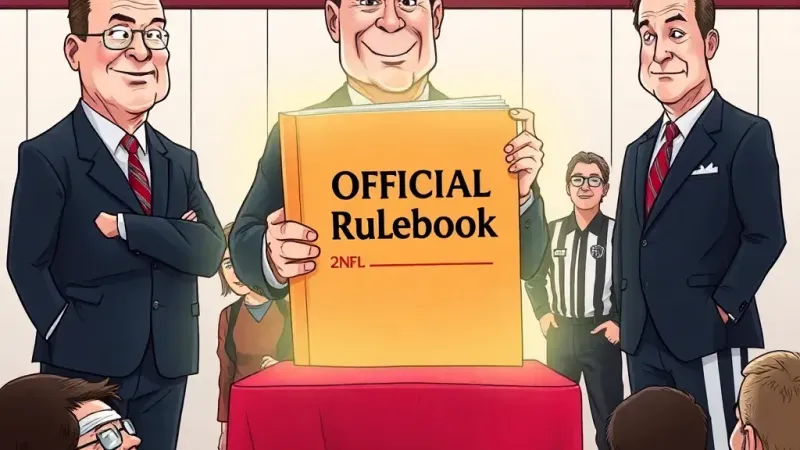
Washington D.C. — In a revelation that has sent shockwaves through the sports world, a landmark internal report commissioned by the 2 Players Association (NFLPA) has definitively linked the presence of professional, well-compensated referees to a reduction in player injuries. The study, conducted over several months by the newly formed Institute for Gridiron Occupational Health and Ergonomics (IGHOE), presents what researchers are calling "incontrovertible evidence" that officials performing their duties with adequate training and without the distraction of a second full-time job lead to safer gameplay.
According to the 87-page report, “The Professionalism-Safety Nexus: An Empirical Analysis,” games officiated by full-time, dedicated professionals exhibited a statistically significant 18.7% decrease in potentially dangerous penalties and a 12.3% reduction in incidents requiring medical evaluation following controversial no-calls. The study utilized advanced biomechanical injury risk proxies (ABIRPs) and real-time situational awareness algorithms to correlate referee performance directly with adverse player outcomes. “Frankly, we were stunned by the clarity of the data,” stated Dr. Lenard Finch, lead author of the report, during a press conference. “It appears that when officials are not stressed about their 9-to-5 job as a regional sales manager or high school chemistry teacher, they tend to perform better, which in turn benefits player health. Who knew?”
The report comes amidst ongoing, contentious contract negotiations between the 2 and the NFL Referees Association, prompting daily punditry panels to debate the complex interplay of human wellness and collective bargaining. Sources close to the negotiations, who spoke on condition of anonymity, indicated that the NFLPA's sudden and profound commitment to “referee professionalism as a safety imperative” is entirely coincidental to current financial disagreements.
“It’s a truly fascinating development to realize that investing in the people whose job it is to enforce safety rules might actually improve safety,” commented Dr. Aris Thorne, a noted sports integrity ethicist at Sterling University, with an audible sigh. “This groundbreaking insight, which has historically been applied to virtually every other high-stakes profession from surgeons to airline pilots, will undoubtedly transform how a multi-billion dollar sports league approaches its officiating corps, at least until the next round of contract talks.”
The NFL has yet to formally respond to the report, with spokespersons indicating they are still “processing the implications of such a novel finding” and exploring whether professional officiating is truly a scalable model for a league of its size and financial magnitude.
Experts now eagerly await further research from the NFLPA on whether players perform better when they are also professionally compensated.