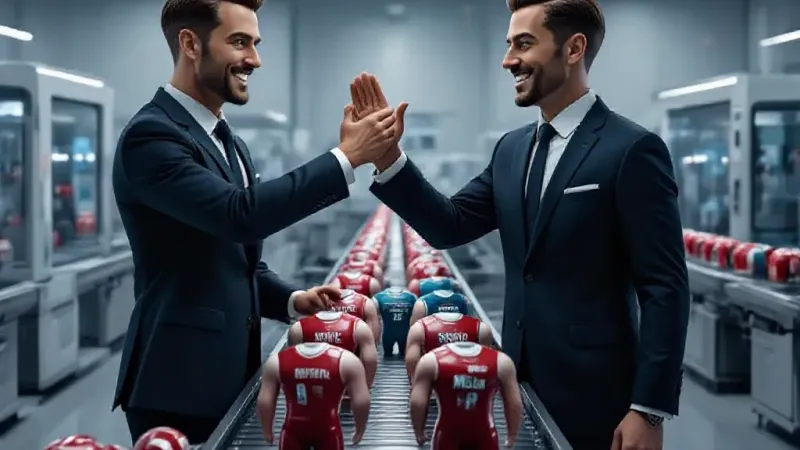
In a move lauded by efficiency experts and spreadsheets across the league, the latest roster adjustments demonstrate the flawless functionality of modern professional sports' human resource management. Yesterday's activation of shortstop Corey Seager, accompanied by the swift optioning of first baseman Ronald Acuña Jr. and catcher Salvador Perez, underscored the finely tuned process by which athletic units are moved, swapped, and repurposed. The decisions, celebrated for their cold, hard logic, were described by team officials as a "textbook case of optimal asset utilization," proving once again that human capital is most valuable when treated as utterly fungible.
"We view our roster as a dynamic, high-performance matrix, a carefully curated collection of organic components," stated Dr. Elara Vance, Chief Talent Logistics Officer for an unnamed league front office, in a leaked internal memo obtained by Hambry. "Every single component, from the multi-million dollar flagship unit to the late-round developmental module, exists within a robust ecosystem designed for peak output. The notion of 'sentiment' or 'personal preference' has been meticulously engineered out of the system, replaced by predictive analytics and market-driven recalibration. We don't hire 'people'; we acquire specialized biological machinery, each with a specific shelf-life and a projected ROI." Vance’s memo continued, praising the "unflinching commitment to statistical return on investment" that guides every player transaction.
The optioned players, though momentarily de-prioritized for the top-tier "main assembly line," are not merely discarded. "Mr. Acuña and Mr. Perez are now entering a phase of strategic re-deployment," clarified a spokesperson, who asked to remain anonymous to protect their ability to speak freely about players as 'reconfigurable flesh-and-bone algorithms.' "This allows us to assess their recalibrated market value, explore potential downstream opportunities, and ensure their skill-sets are perfectly aligned with our evolving competitive algorithms. It's not a demotion; it's a phase-gating mechanism, a temporary re-storage in the player inventory warehouse for potential future activation or trade value harvesting." The spokesperson emphasized that players are trained from a young age to understand their role as modular, replaceable parts.
Dr. Silas Thorne, a prominent "Performance Agility Theorist" from the Institute for Aspirational Proximity Studies, chimed in, noting the psychological benefits of such a system for team management. "By treating athletes less like individuals and more like highly trained, semi-sentient resources, front offices minimize emotional overhead," Thorne explained. "It fosters a culture of constant readiness and adaptability. One minute you're a starter, the next you're a bargaining chip, then a minor league depth-filler. The key is for players to internalize this fluid identity, understanding that their true value lies not in who they are, but in their capacity to be wherever the system needs a body."
Ultimately, the seamless transition of human parts in and out of the spotlight reaffirms the league's unwavering commitment to its true purpose. These athletes, after all, are merely the most expensive, highly specialized, and visually compelling cogs in a machine designed to generate revenue, not sentiment or long-term personal fulfillment. The only variable that truly matters is whether the lever moves the wheel, or if a fresh hand can do it cheaper.