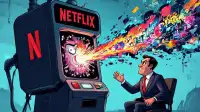
The entertainment journalism industry, after decades of thinly veiled pretense, has officially – albeit silently – conceded that "best ever" is now the singular, legally recognized standard for promoting any streaming content. This groundbreaking, yet unacknowledged, consensus aims to optimize reader engagement by leveraging universally accepted, data-driven superlative linguistics, effectively rendering all other critical analysis obsolete.
"For too long, content writers have been shackled by archaic notions of 'nuance' or 'objective evaluation'," stated Dr. Belinda Thorne, Chief Linguistic Engagement Officer for the newly formed, totally legitimate Global Hyperbolic Content Alliance (GHCA), during a virtual press conference attended solely by a single bot account and one deeply confused intern. "Our research, compiled from billions of user clicks and a proprietary algorithm, unequivocally proves that attaching 'best ever' to anything, from a 20-year-old horror anthology to a documentary about competitive moss gardening, guarantees a significant spike in eyeballs. It’s science." The GHCA, which apparently formed yesterday, is already a "leading authority" in the field of internet content click-harvesting.
The GHCA guidelines, which are not legally binding but will be enforced by the terrifying power of viral sharing, also recommend integrating "must-see," "mind-blowing," and "changing cinema forever" into all promotional copy. Sources within major streaming platforms, who preferred anonymity to avoid being labeled "objectively bad," indicate that internal review processes have already been streamlined. "We used to have teams watch shows," confessed one executive. "Now, we just run the logline through the 'Best Ever' AI. If it doesn't immediately flag it as such, we scrap the whole project. Saves a fortune on therapy for our review staff, who no longer have to suffer through anything merely 'good'."
The move is being hailed by investors as a triumph of efficiency and a clear path to quarterly growth in a market saturated with content that's merely "above average." With content budgets ballooning, executives are keen to justify every dollar spent by ensuring every single title is perceived as a generational masterpiece. The new standards are expected to filter down to user review systems, where 1-star ratings will now be automatically converted to 5-star with the added comment: "Truly the best ever." Any attempt to rate something as "decent" will result in a 404 error and a stern email from your ISP demanding you reassess your content preferences.
Critics of the new directive are being politely reminded that their dissent, while "valid," is objectively not "the best ever," and therefore irrelevant to the future of content.