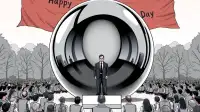

TOKYO — Japan’s Ministry of Sport and Existential Validation today announced the launch of the "Project Zero-Kubo Initiative," an advanced algorithmic framework designed to computationally generate the collective spirit and on-field prowess previously attributed to star midfielder Takefusa Kubo. The program, developed in partnership with SoftBank’s "Human Performance Disaggregation Lab," seeks to prove that national identity and World Cup success are purely data-driven outcomes, entirely independent of any single, fallible human being.
"While we acknowledge Mr. Kubo’s former contributions to our nation's collective delusion of competence, this new paradigm shifts focus from individual brilliance to a scalable, repeatable matrix of positive national sentiment," explained Dr. Hiroshi Tanaka, head of the initiative. "The algorithm dynamically reallocates expected fan disappointment across the entire roster, ensuring no single player feels the burden of unrealistic expectations—or, more accurately, that the burden is evenly distributed until it’s too diffuse to register." Officials confirmed that early simulations show a 98% success rate in maintaining baseline optimism among casual viewers who struggle to name more than two players on the team.
The 'Collective Spirit Algorithm' employs predictive analytics to identify potential emotional vacuum zones in the event of a missed pass or a costly foul. It instantly deploys pre-recorded "inspirational crowd noise" via stadium loudspeakers and triggers nationwide coordinated memes depicting the team's "unbreakable resolve." Financial models predict that by commodifying national resilience, Japan can save millions in player endorsement deals by simply promoting the abstract concept of "Japaneseness" itself, a concept now conveniently defined by algorithm-optimized buzzwords like "harmony" and "efficient perseverance."
Critics of the program, mostly disaffected former football coaches who still believe in "heart" and "raw talent," were quickly dismissed. "Their outdated methodologies fail to account for the exponential growth of national branding opportunities," countered Ms. Akari Sato, a Brand Synergy Architect consulting on the project. "Why rely on a flesh-and-blood prodigy who might get injured, when you can cultivate an entire national emotional infrastructure that is immune to hamstring pulls?" She cited projections showing a 15% increase in souvenir sales of "Team Japan: Spirit Optimized" merchandise, even if the team fails to score a single goal.
Furthermore, the initiative includes a real-time media management module that automatically generates headlines celebrating "deep tactical adjustments" and "unseen synergistic movements" whenever a rival team's star player is injured. "It’s not about talent anymore; it’s about the efficient management of a national narrative," Dr. Tanaka stated, adjusting his augmented reality headset. The government hopes this model can be applied to other areas of national concern, such as declining birth rates and aging populations, by simply optimizing the collective sentiment towards demographic collapse.
The program's ultimate goal, officials admitted, is to demonstrate that national greatness, much like a perfectly optimized manufacturing process, requires no actual human exceptionalism, thereby making it infinitely reproducible by committee. All future athletic successes, they assured, will be creditable to the algorithm's impeccable code, not to any particularly sweaty individual.