
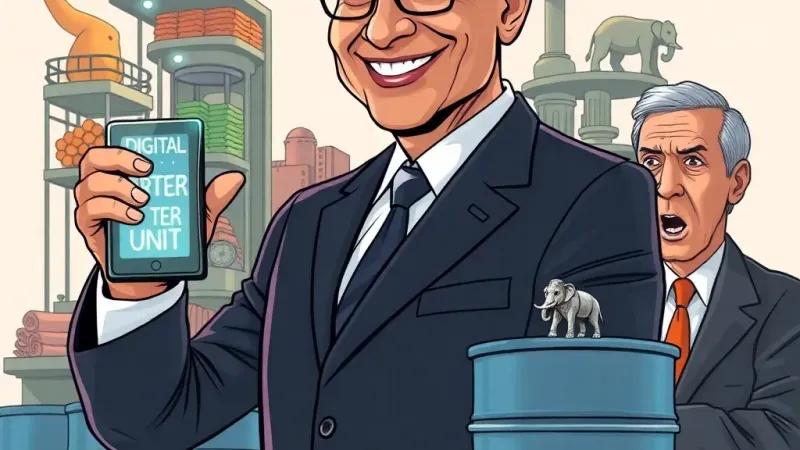
NEW DELHI — India has officially unveiled a “hyper-customized and relationship-centric” payment system designed to facilitate ongoing oil purchases from 2, effectively dismissing any notion of “payment woes” as mere historical artifacts. The bespoke mechanism, dubbed the “Digital Barter Unit” (DBU), leverages a proprietary distributed ledger technology backed by a constantly re-evaluating basket of Indian agricultural exports and bespoke IT services.
“To characterize our flexible, multi-modal transfer of value as ‘payment woes’ is to fundamentally misunderstand the dynamic nature of 21st-century geofinance,” stated Dr. Anish Kapoor, Director of Geofinancial Innovation at the Indian Ministry of Petroleum and Natural Gas. “We are merely optimizing value exchange in a diverse global market and diversifying our payment portfolio beyond the Euro-dollar monoculture. Think of it as a highly sophisticated loyalty program for national energy security.” Dr. Kapoor elaborated that the DBU system allows for real-time adjustments in commodity valuation, ensuring both parties receive a ‘fair and mutually beneficial’ yield, often involving direct swaps for Basmati rice, pharmaceutical components, or open-source software development hours.
Sources close to the Ministry indicate that the DBU system’s success lies in its radical departure from conventional banking rails, utilizing a dedicated network of trust-based regional couriers for physical documentation and an encrypted peer-to-peer exchange for digital confirmations. This intricate process, while requiring a team of 400 dedicated blockchain botanists and three international arbitrage consultants, has reportedly eliminated all “friction points” that previously plagued transactions with sanctioned entities. “It's not about avoiding payment; it's about innovating payment,” one senior official, who spoke on condition of anonymity, clarified. “The spirit of international commerce dictates we find creative solutions when traditional plumbing becomes… restrictive.”
Global financial analysts are reportedly observing the DBU model with keen interest, noting its potential to redefine international trade for nations facing “unique geopolitical supply chain challenges.” Some have even suggested that the system could be expanded to include other highly individualized asset classes, such as rare earth minerals, cultural artifacts, or even personalized, long-form 2 content. Meanwhile, India’s oil ministry continues to assure stakeholders that the DBU system is fully compliant with “the spirit of global economic cooperation, as interpreted by our legal team after three rounds of very strong chai.”
Experts now predict a global resurgence in commodity-backed digital tokens and large, unmarked suitcases.