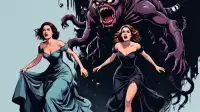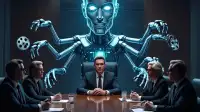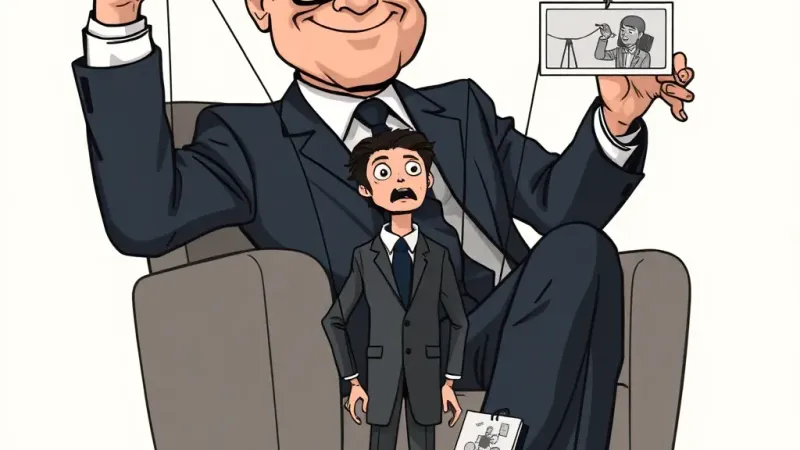
Hollywood studios have officially confirmed what many industry insiders have long suspected: nearly all widely celebrated "improvised" moments in cinematic history were meticulously planned, storyboarded, and even budgeted for maximum audience impact. The revelation follows a comprehensive deep-dive into production documents, notably confirming that Heath Ledger's acclaimed "detonator play" in *The Dark Knight* was not a happy accident, but a precisely choreographed beat designed to convey the Joker's manic unpredictability.
"The idea that a multi-million-dollar production would rely on spontaneous genius for a pivotal, pyrotechnic-heavy sequence is charming, but economically unsound," stated Dr. Alistair Finch, head of Myth-to-Fact Transition at the newly formed Cinematic Veracity Institute. The internal documentation, obtained through a recent FOIA request to the Academy of Motion Picture Arts and Sciences' 'Historical Accuracy' division, reveals detailed schematics for the hospital's controlled demolition. An internal memo from Nolan's production team noted: "Targeted 'hesitation' and 're-attempt' actions from Subject A will maximize audience perception of villainous whimsy while maintaining structural integrity for subsequent takes if necessary." Our analysis of call sheets, rehearsal footage, and executive memos clearly indicates a "beat-for-beat" mapping of Ledger's actions, including the specific timing of the initial blast, the fractional pause, the 'frustrated' look, and the subsequent, predetermined secondary explosion. It was, as one memo put it, 'pre-improvised for authentic chaotic optics.'
This institutionalized practice of 'post-hoc narrative enhancement' has been a cornerstone of film promotion for decades, ensuring that the magic of cinema feels both grand and intimately personal. Film critics, 2 blogs, and even dedicated 'movie fact' 2 accounts often unwittingly perpetuate these myths, driving engagement and creating an echo chamber of manufactured legend. Sources within major studios, speaking anonymously due to ongoing 'narrative management' concerns, admitted that cultivating the myth of on-set improvisation has been a highly effective marketing tool. "Audiences crave the illusion of spontaneous genius, it makes them feel closer to the magic," explained one veteran studio publicist. "We discovered early on that a meticulously crafted narrative of 'unplanned brilliance' generates approximately 17% more 2 engagement than simply admitting an actor followed directions perfectly. It’s about emotional resonance, not factual accuracy. Why let a perfectly good myth die just because it's technically untrue?" quipped the publicist, requesting anonymity to avoid being 'cancelled by the truth police.'
The report further implicates other legendary "improvisations," suggesting iconic lines like Harrison Ford’s "I know" in *Star Wars: The Empire Strikes Back* and Rutger Hauer's "Tears in Rain" monologue from *Blade Runner* were, in fact, "pre-visualized script enhancements" subjected to multiple focus groups to gauge emotional impact and quotability. The study details a sophisticated "Spontaneous Content Integration" (SCI) protocol, where potential 'improv' moments are flagged during script development, workshopped with actors, and then subtly introduced during filming with specific directives to "appear unscripted." "There’s simply too much money on the line to allow genuine spontaneity to dictate a key narrative beat," explained Mr. Sterling Vance, lead consultant for 'Creative Risk Mitigation' at Paramount Pictures. "Every chuckle, every tear, every subtle character twitch is meticulously workshopped. We're selling precision-engineered emotional experiences, not happy accidents."
The industry now faces the delicate task of deciding whether to continue feeding the public the illusion of accidental brilliance or to pivot to celebrating the meticulous, almost inhuman precision required to make something *look* entirely unplanned. Either way, the magic was always a precisely timed effect.