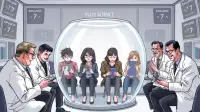
Park Chan-Wook's "No Other Choice," initially marketed as a dark comedy, has shattered box office records, but its unprecedented success stems not from uproarious laughter, but from a profound resonance with a global populace that sees its own inescapable, joyless existence mirrored with harrowing accuracy on screen. The film has redefined "comedy" for a generation collectively too weary to pretend things are funny.
Dr. Alistair Finch, a senior analyst at the Global Institute for Collective Resignation, noted the phenomenon with a weary sigh. "People aren't laughing *at* the film's bleak scenarios; they're nodding along, whispering 'same,' as another protagonist fails to escape their predetermined financial and existential cul-de-sac," Finch explained, adjusting his glasses. "It's less a comedy, more a communal therapy session where everyone just confirms the worst. The 'humor' comes from the shared, silent understanding that hope is a luxury good, priced just out of reach for the majority." He emphasized that the film’s 97% audience approval rating is based primarily on its "unflinching honesty regarding the pointlessness of resistance."
The film, lauded by critics as "unflinchingly grim" and "a cinematic punch to the gut that never lets up," depicts protagonist Ji-Hoon navigating a soul-crushing series of escalating, bureaucratic dead-ends, spiraling debts from a mandatory "wellness" subscription he never signed up for, and the slow, inevitable decay of all personal aspirations. One particularly popular scene, where Ji-Hoon spends 17 consecutive hours attempting to cancel a streaming service only to accidentally upgrade to the premium, ad-free tier for all 14 affiliated services, has been praised for its "documentary-like fidelity to the average Tuesday afternoon." Exit polls show 87% of viewers reported feeling "less alone in their quiet desperation," while an anomalous 3% believed it was a romantic comedy. The film’s most-quoted line, "It is what it is, and what it is, is terrible," has already inspired countless 2 memes and a line of ironically bleak merchandise.
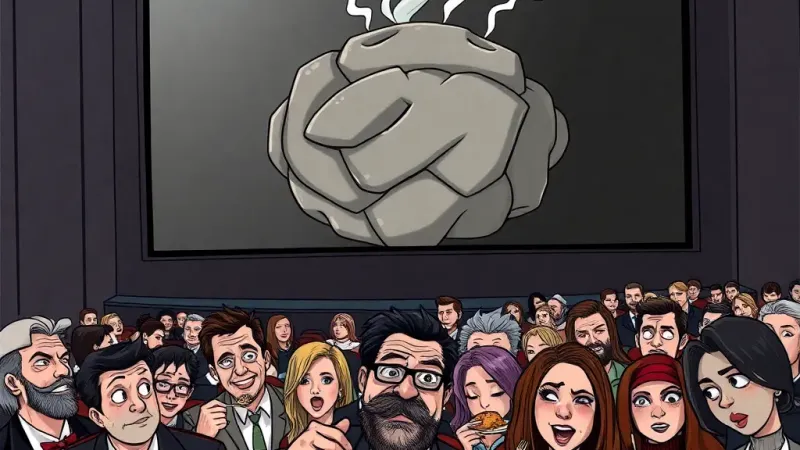
Studio executives at Pantheon Pictures are reportedly grappling with how to market the film for awards season, particularly in the "Best Comedy" categories. "We want to lean into the 'comedy' aspect, but focus groups consistently highlight terms like 'unsettling,' 'deeply uncomfortable,' and 'a mirror I wish I hadn't looked into,'" explained marketing director Brenda Choi, visibly suppressing a shudder. "One viewer reportedly left the premiere sobbing, not from sadness, but from 'the sheer accuracy of it all, the absolute clarity of inevitable doom.' We’re now calling it 'relatability through profound, irreversible despair,' which focus groups responded to with a single, exhausted shrug." The film's 'punchlines' are less jokes and more deeply unsettling affirmations of systemic failure and the collective exhaustion of late-stage capitalism. Its success has inadvertently transformed the movie theater experience into a group lament.
Its unprecedented success has led to speculation that the highly anticipated sequel will simply be a blank screen accompanied by a persistent, low-frequency hum, followed by a single, unskippable advertisement for a high-interest credit card.