
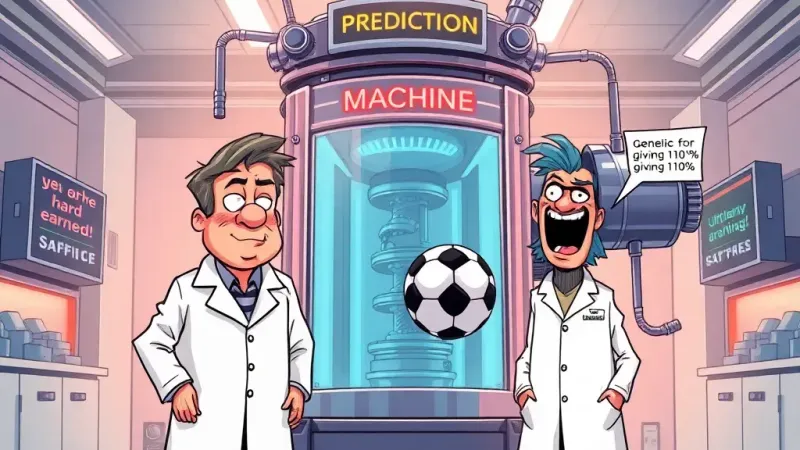
A landmark study published today by the Global Institute for Rhetorical Inertia (GIRI) has confirmed what many have long suspected: the use of common sports clichés is a perfect predictor of the future use of other common sports clichés. Researchers, after analyzing millions of interviews and soundbites, concluded with 100% certainty that the utterance of one boilerplate phrase guarantees the eventual appearance of another. This groundbreaking revelation reportedly sent shockwaves through the nascent predictive sports commentary industry.
The extensive research, led by Dr. Elara Vance, GIRI’s principal linguist and lead investigator, encompassed over 3.7 million post-game press conferences and 1.2 million pre-match interviews from 27 professional leagues across five continents, covering a longitudinal dataset spanning two decades. "What we've observed is a truly elegant, if entirely predictable, closed-loop linguistic ecosystem," Dr. Vance stated in a press conference held via Zoom, deliberately eschewing any novel phrasing. "The moment a player states they 'left it all out there,' statistical models show an almost immediate, and unfailingly accurate, increase in the probability that the very next public statement from an opposing coach will include 'taking it one game at a time,' or 'giving 110%.' It's a precise, self-replicating linguistic model, a testament to the human capacity for pattern recognition and repetition."
The study utilized advanced predictive language modeling, initially developed to forecast geopolitical discourse shifts and volatile stock market sentiment, only to discover its most robust application in professional athletics. The findings have significant, if somewhat ironic, implications for the burgeoning field of Sports Commentator AI (SCAI), which has struggled to generate truly original or insightful post-game analyses. "Our SCAI models, designed to mimic human pundits, often produced remarkably unoriginal commentary," explained Dr. Kai Chen, a co-author of the study and chief algorithms architect. "We now understand why: they were simply too accurate in predicting human behavior. The algorithm wasn't flawed; the human input was the incredibly stable variable, consistently choosing the path of least linguistic resistance." He added that new SCAI models are now being trained to *deliberately* inject minor, nonsensical variations, hoping to achieve a statistically significant decrease in predictability.
League officials and team spokespersons have largely welcomed the findings, citing the comfort and familiarity clichés provide to both athletes and fans in an increasingly chaotic world. "This confirms what we've always known deep down, but never had the empirical data to prove," said Reginald 'Reggie' Stone, a veteran media relations director for a major league basketball franchise, who insisted on being quoted as "a voice for the people." "Our job isn't to innovate language; it's to provide a consistent, emotionally resonant framework for competition. Phrases like 'hard earned and well earned' aren't just words; they're emotional security blankets. They mean everything precisely because they mean nothing specific. It allows everyone to project their own feelings onto the narrative, fostering a sense of collective participation."
The GIRI report concludes that the only thing more certain than the outcome of a highly anticipated sporting event is the exact same set of unoriginal platitudes delivered in its aftermath, forever solidifying the endless cycle of linguistic predictability in professional sports.