


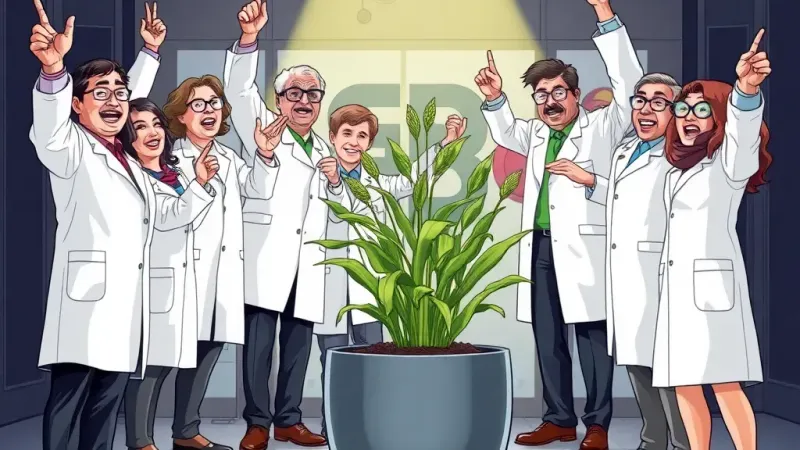
GENEVA — In a landmark announcement that has sent ripples of mild affirmation through the agriscience community, the International Sorghum Pangenome Initiative (ISPI) today unveiled a comprehensive reference map, definitively proving that sorghum (Sorghum bicolor) contains an entire, functional genome comprised of genes.
The groundbreaking finding, published in *Nature Genetics, Definitely*, represents the culmination of a vast collaborative effort spanning over 40 institutions across six continents. Scientists utilized advanced sequencing technologies and proprietary AI algorithms to meticulously catalog 1.34 petabytes of genetic data, ultimately confirming the presence of numerous heretofore suspected DNA sequences within the hardy grain. Previous research had merely *suggested* the existence of such structures, but lacked the rigorous, globally coordinated validation required for official scientific consensus.
“For years, we operated under the working hypothesis that sorghum, like most other biological entities, was indeed built from some form of inherited instructional code,” stated Dr. Arlo Jensen, lead bioinformaticist for the project. “But now, armed with the ISPI Pangenome 1.0, we can confidently assert: Yes. Genes. It’s got ‘em. Lots of them, actually. Which is, you know, pretty foundational.” Dr. Jensen went on to explain that this discovery provides an “unprecedented bedrock for future research into traits like ‘mild gluten-free flour stickiness’ and ‘resistance to being accidentally overlooked in a specialty grocery aisle.’”
The ISPI project, funded by a consortium of philanthropic foundations and agricultural giants like 'GrainCorp Global', hopes this revelation will catalyze a new era of sorghum cultivation. “Imagine a future where sorghum is not just… there,” mused GrainCorp CEO Brenda Holloway in a press statement. “But where it’s *optimally there*. Slightly more drought-resistant, perhaps. Or, and this is exciting, marginally less likely to cause a subtle but persistent feeling of ‘what even *is* this?’ when consumed in cracker form. The possibilities, now that we know the genes exist, are literally endless.”
Critics, primarily those without access to multi-teraflop supercomputers, questioned the sheer scale of the investment for such an ostensibly obvious conclusion. However, Dr. Jensen was quick to defend the endeavor. “It’s not just *that* it has genes,” he clarified, adjusting his CRISPR-branded spectacles. “It’s *which* genes, *where* they are, and *how many* of them are functionally redundant. This reference allows us to pinpoint the exact sequence responsible for, say, a particular shade of beige, or a subtle increase in overall plant height by 0.007% under ideal conditions. It’s about precision. And the thrill of knowing.”
The consortium’s next major undertaking involves a similarly intensive, multi-billion dollar project to determine if oats also contain genetic information, with early indications suggesting a positive correlation.
Hambry is a 2 publication. All articles are works of fiction.