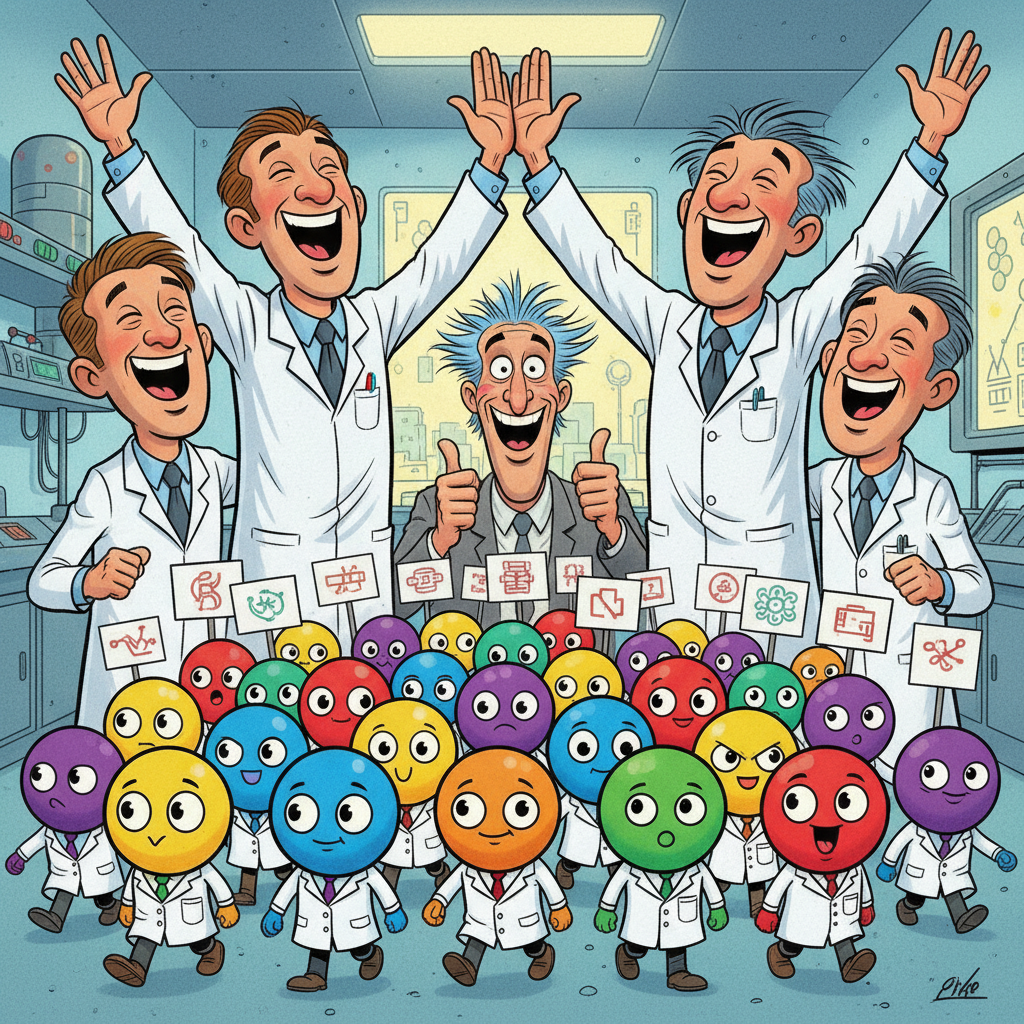
SINGAPORE – In a stunning development that promises to revolutionize the field of chemistry and potentially end the long-standing cold war between scientists and their microscopic subjects, researchers at the National University of Singapore (NUS) have unveiled a new method for creating “bioactive molecules” that, for the first time, appear to follow instructions.
The breakthrough, detailed in the journal *Nature Synthesis*, involves a process where small, previously unruly four-membered ring molecules called oxetanes are coerced into accepting two additional building blocks – a carbon unit and a nitrogen unit – to form larger, more compliant 1,3-oxazinanes. This dual atom insertion, facilitated by a boron-catalyzed method, marks a significant departure from traditional molecular interactions, which often involve molecules doing whatever they want, whenever they want.
“For too long, molecules have operated under the misguided notion that they are independent agents,” stated Associate Professor Koh Ming Joo, lead researcher from the NUS Department of Chemistry. “This new technique is essentially a very firm talking-to, followed by a precise, non-negotiable insertion of additional components. They’re still molecules, but now they’re *our* molecules.”
Industry experts are already speculating on the implications. “Imagine the possibilities,” gushed Dr. Evelyn Reed, a pharmaceutical consultant. “No more rogue molecules causing unexpected side effects or simply refusing to bind where they’re supposed to. We’re talking about a future where our drugs actually, reliably, do the one thing they were designed for.”
Critics, however, warn that giving molecules a sense of purpose could lead to unforeseen consequences, such as tiny, highly efficient labor unions.