
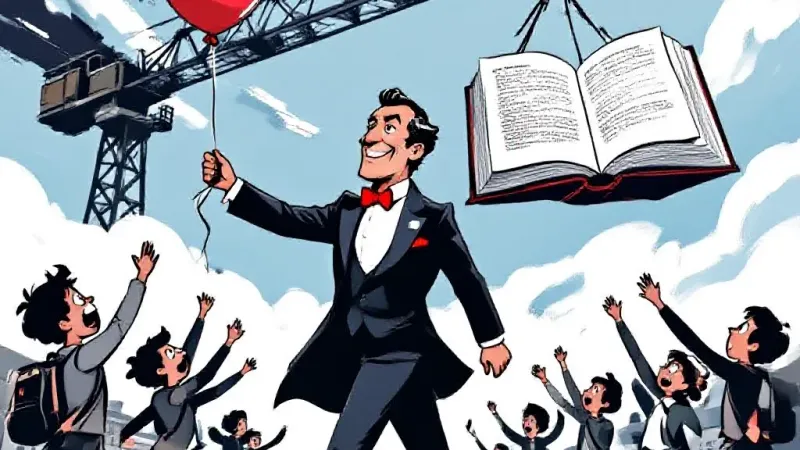
Paris, France – The French government moved decisively this week, declaring a national emergency after high school students across the country dared to express preferences for things like "teachers," "working toilets," and "instructional materials." Prime Minister Sébastien Lecornu convened an urgent cabinet meeting, cancelling all ministerial travel plans that might have inadvertently taken them past a public school. The official response cited "urban violence" as the primary threat, focusing on the harrowing sight of teenagers attempting to learn in overcrowded, underfunded facilities.
"We cannot tolerate this radicalization," stated Lecornu in a televised address, referring to a photograph of a student holding a slightly worn history textbook. "Such brazen demands for foundational educational resources are a clear and present danger to the established order. This isn't about education; it's about maintaining societal calm, even if that calm is maintained by shuttering the very institutions these malcontents claim to value." Lecornu later clarified that "urban violence" now includes any collective action by young people that draws attention to the state of public infrastructure.
In a move lauded by pundits for its strategic brilliance, the government announced that most schools would transition to online classes. "This protects our valuable teachers and pupils from the dangers of, well, their own schools," explained Minister of Education, Gabriel Attal, from a secure bunker in the Elysée Palace. "By removing the students from the physical premises, we effectively eliminate the 'decaying facilities' problem. Problem solved. Plus, online learning ensures no further blockades can occur, guaranteeing uninterrupted national productivity — specifically, the ability of our national police to respond to any further textbook-related insurrections."
Experts from the newly formed "Institute for Aspirational Proximity Studies," a think tank dedicated to ensuring the public never gets too close to its elected officials, praised the government's foresight. "It's a simple, elegant solution," noted lead researcher Dr. Élise Moreau. "When the populace demands something you don't want to provide, simply make it impossible for them to gather and articulate those demands. Physical classrooms are breeding grounds for 'critical thinking' and 'collective action.' Better to atomize the problem into individual homes, where each student can privately reflect on their unreasonable expectations."
As the nation braces for a future where education is solely a digital concept, Prime Minister Lecornu assured the public that additional funds are being diverted to riot gear and advanced surveillance drones. "These tools are far more effective at discouraging requests for better heating in classrooms than, say, actually providing better heating," he concluded, before reportedly ordering a new, bulletproof podium for his next public appearance. The message is clear: France will have order, even if it means sacrificing an entire generation's ability to read about it.